How to Fund Universal Basic Income by Taxing Consumption: Over $450 a Month From a VAT

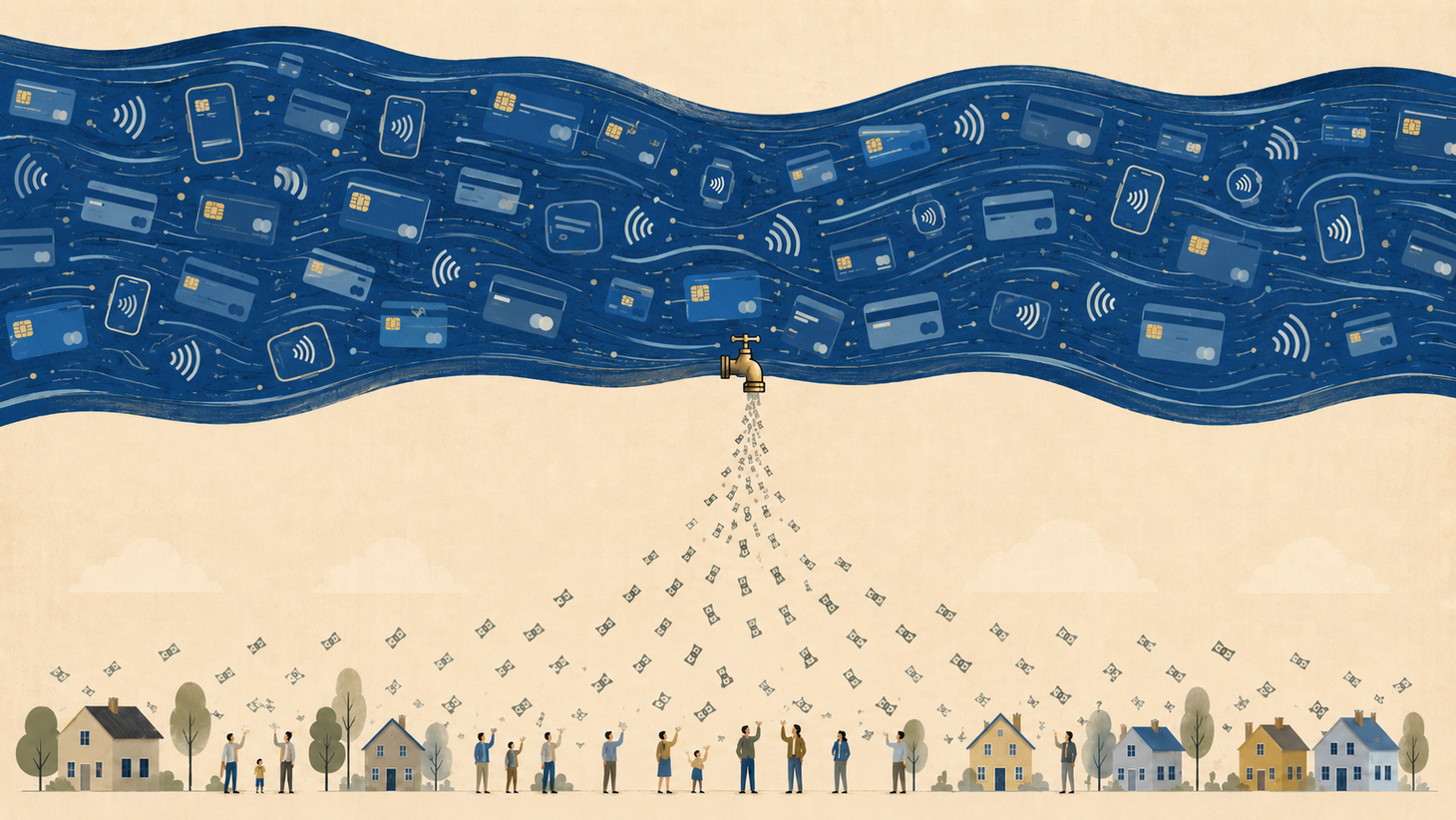
Pairing a 10% value-added tax or a tiny 0.1% automated transaction tax with UBI transforms a regressive tax into a progressive dividend for every American
A 10% value-added tax (VAT) in the United States could raise about $1.76 trillion a year — enough to fund a universal basic income of more than $450 per month for every American citizen and green card holder, adult and child alike, with no deficit spending. So could a tiny 0.1% tax on every transaction that moves through our banking system. In this article I’m going to walk through both options, because I believe a consumption tax is another natural layer of UBI funding. More than 170 countries have a value-added tax, including every single member of the OECD except one. Guess which one. The average standard rate across the OECD is about 19%. Hungary’s is 27%. The UK’s is 20%. Even famously tax-averse Australia has one at 10%. The question isn’t whether a VAT can work. The question is why the wealthiest country on Earth refuses to use the third-largest revenue source in the developed world.
I think part of the answer is that Americans believe consumption taxes hurt the poor. And they’re right — if the revenue disappears into the general fund. But pair a consumption tax with a universal basic income, and something remarkable happens. A regressive tax becomes progressive in outcome.
This article is a sequel of sorts. I’ve already written about replacing the standard deduction with a $375 monthly Standard Tax Credit, and a 1.5% stock dilution tax that would fund a $365 monthly universal dividend. The first layer reforms how we tax income. The second layer taxes wealth in a way no billionaire can escape. This third layer taxes consumption, and I’ll show you two different ways to go about it.
Option one: the 10% VAT
Andrew Yang made the VAT famous in American politics by proposing a 10% rate to help fund his Freedom Dividend. I informally advised him on that, and I still believe it makes good sense. So let’s run the numbers with a maximally broad base, the way New Zealand does it. Tax nearly everything, exempt as little as possible, and handle fairness on the spending side instead of carving holes in the tax side.
Americans now spend just about $22 trillion a year on personal consumption. Even the broadest VAT base ever modeled for the US captures about 80% of that consumption. The roughly 20% it leaves out isn't groceries or clothing; it's the handful of things that are genuinely hard to tax or that nearly every country exempts: government-financed health care like Medicare and Medicaid, education, the services of churches and charities, and the estimated value of banking services that customers pay for indirectly through lower interest on deposits or higher interest on loans instead of through direct fees. Housing gets handled the way most VATs handle it. Rather than taxing the rent people pay month to month, the base taxes the purchase of new homes, treating a house like the durable good it is. That leaves a base of roughly $17.6 trillion. A 10% rate on it raises $1.76 trillion a year.
Now for the dividend. Like every layer in my proposed UBI stack, this one goes to citizens and green card holders. That’s everyone with permanent legal status, adult and child alike, equally. The Census estimates about 342.6 million US residents as of June 2026, and while the Bureau doesn’t tabulate legal status, subtracting temporary and unauthorized residents leaves roughly 320 million citizens and lawful permanent residents. Divide $1.76 trillion by 320 million and you get $5,500 a year or about $458 per month (or $517/mo per adult and $259/mo per child). Call it a deficit-neutral consumption dividend.
I want to be clear about the range here. Estimates with narrower bases come in lower. Yale’s Budget Lab modeled about $1 trillion from a 10% VAT in 2025, and economist William Gale’s plan for Brookings raised $842 billion in 2020 on a base covering only 64% of consumption. The lesson here is that every exemption shrinks the dividend. Exempt food, exempt clothing, exempt this and that for seemingly compassionate reasons, and you end up mailing smaller checks to the very people the exemptions were supposed to protect. The optimal design in my opinion is the broad one.
Doesn’t a consumption tax hurt the poor?
Yes. Alone, it absolutely does. A VAT is regressive by nature because the less money you have, the larger the share of it you must spend on basics. So let’s take one of the hardest cases imaginable.
Picture someone who is homeless and can spend only $1,500 a year on food. A 10% VAT turns that cost into $1,650. We just made one of the poorest people in America pay another $150 a year to eat. That’s indefensible if that’s where the story ends.
But it’s not where the story ends. That same person would also receive $458 a month in UBI. Subtract the $150 they paid in VAT and they come out $5,350 ahead — money for food, for shoes, for a phone to apply for jobs with, or their share of rent. The tax took $150 with one hand and the dividend gave back $5,500 with the other. Run that arithmetic up the income ladder and you find the crossover point: anyone spending less than $55,000 a year on taxed consumption comes out net positive. Anyone spending more becomes a net payer. The combination functions as a negative consumption tax — an alternative to Milton Friedman's negative income tax, working through consumption instead of income.
That’s the beauty of it. A consumption tax is regressive in nature but the pairing with UBI is progressive in outcome, and the more someone consumes, the more they fund everyone else’s basic income. The person buying a third yacht pays for a lot of people’s groceries.
And here’s the part that should make this especially interesting: conservatives already agree. The Republican FairTax plan — a national sales tax beloved by the Freedom Caucus — includes a monthly cash payment of around $300 to every household called the “Family Consumption Allowance,” precisely because its authors understood that taxing consumption without rebating it would tax people into poverty. I’ve written before about how the FairTax “prebate” is a UBI. Anyone who supports the FairTax has already conceded the principle: a consumption tax requires a UBI in order to be fair. We’re not debating whether anymore. We’re debating how.
Even the economists who conservatives most respect lean this way. Greg Mankiw, who chaired George W. Bush’s Council of Economic Advisers, uses a story of two hypothetical CEOs, Sam Spendthrift and Frank Frugal. Sam blows his fortune on lavish parties, private jets, and island vacations. Frank invests his, financing the capital and technology that grows the economy. An income tax treats them identically. Mankiw’s point is that the tax code should distinguish between them. A consumption tax does. It taxes the spending, not the producing. Pair it with UBI and you get the version that helps the poor and working class.
But won’t prices just rise to eat it?
This is the other great fear about UBI, right alongside the worry about work: give everyone money and businesses will simply raise prices to capture it, leaving people no better off. It’s a fair worry but a multivariate one. And a VAT-funded UBI answers it in a way no other funding source can, because the tax and the dividend are both coupled to prices.
The dividend is funded by a percentage of what people spend, so when prices rise, the tax collected on them rises too and so the dividend rises right along with it. If a gallon of milk goes from $4 to $5, the dime the government collects flows into the same faucet that pays everyone’s monthly check. This UBI is thus self-indexing. We already have a cruder version of this in Social Security’s annual cost-of-living adjustment, the COLA. But the COLA is calculated once a year off a backward-looking index, always chasing last year’s inflation. A VAT-UBI indexes continuously — no annual vote, no formula to argue over, no lag. It’s a COLA without the committee.
The tax that reaches everyone
Here’s something an income tax can never do that a consumption tax can: reach the money that was never income in the first place. The wealthiest Americans have largely opted out of the income tax, and they’ve done it legally. The playbook is well known. Buy assets, borrow against them, and let the estate settle the rest. A billionaire can live lavishly for decades on loans secured by stock they never sell, and because a loan isn’t income, the income tax never touches it. My other UBI layer proposals go after this from two directions already: the Standard Tax Credit proposal taxes capital gains as ordinary income and adds a wealth tax that reaches fortunes whether or not they’re ever sold, and the stock dilution tax skims a share of corporate equity straight off the top. A consumption tax adds a third vector. The moment that borrowed money is spent on the yacht, the jet, or the third home, it gets taxed, because spending is spending no matter where the money came from. Income when it’s earned, wealth while it’s held, consumption when it’s spent: three different angles on the same fortune, and borrowing only slips past the first. A consumption tax doesn’t replace taxing wealth. It catches what the others miss, because eventually, everyone spends.
And it catches more than just the rich. It reaches undocumented immigrants and tourists — everyone physically present, buying things, contributing to the system. I don’t mean that as anti-immigrant or anti-tourist. I mean it as a feature with a good incentive structure. Under a VAT-UBI, every new arrival makes the dividend a little larger for everyone who receives it. The more tourists, the higher your UBI. The more immigrants, the higher your UBI. People who today are told to resent newcomers as a drain would have a direct, personal stake in welcoming them.
For undocumented immigrants specifically, the dividend creates something we don’t currently offer: a built-in reason to follow the rules. Pay the consumption tax with no green card and you get nothing back. Get legal status and the same tax now comes paired with a monthly dividend. That’s a powerful, non-punitive nudge toward legal immigration — but only if the system actually works. Right now it doesn’t. We’ve built an immigration process that is, for most people, an endless labyrinth of waiting lists, backlogs, and immigration courts without even close to enough resources to handle the load. You can’t credibly tell people to “just immigrate legally” when the legal door is, in practice, bolted shut. So this argument comes with a caveat: it works only if we fix the broken system first and make legal immigration a real choice instead of a decades-long maze. Build that functioning doorway, and the dividend gives people every reason to walk through it instead of around it.
The SNAP question: stack it or swap it?
A $458 monthly dividend is high enough to create a choice the other layers can’t, and I want to lay out both sides of this, because it’s genuinely an option, not a requirement.
Option A: add the layer on top of SNAP. Everyone keeps their food assistance and gets the dividend too. Simple. Maximally generous for SNAP recipients. But not everyone in need of food assistance is a SNAP recipient. Only about three out of five people below 130% of the poverty line get SNAP benefits.
Option B: replace SNAP with the dividend, and make it larger. SNAP cost about $100 billion in fiscal year 2024. Fold that into the dividend pool and the monthly amount rises from $458 to roughly $485 per person (or $546/mo per adult and $273/mo per child). And here’s the key fact making replacement possible: the maximum SNAP benefit is $298 a month for an individual and $994 for a family of four, which works out to about $249 per person. Both dividend variants — $485 for all or $546 per adult and $273 per child — exceed the maximum SNAP benefit for every household size. No one would receive less than they do today, and most would receive far more, because the average SNAP benefit is only about $187 per person. And those two out of five people below 130% of the FPL that SNAP doesn’t reach would be reached by the UBI.
I prefer replacement, and I want to explain why, beyond reaching all five of five.
Cash is better than vouchers. SNAP can buy groceries and nothing else. It can’t buy diapers. It can’t buy tampons. It can’t buy soap, toilet paper, a winter coat or blanket, or the gas to drive to the only grocery store within twenty miles. Cash can buy any food anywhere food is sold, and everything else a human being needs to live. Vouchers say “we don’t trust you.” Cash says “you know your life better than we do.” That trust isn’t a side benefit. After a decade of watching cash transfer evidence accumulate from around the world, I’d argue that trust is the key. Dignity does things for people that paternalism and surveillance never will.
And then there’s the marginal tax rate. SNAP phases out as you earn income. It drops by 30 cents for every additional dollar earned. That’s a 30% marginal tax rate stacked on top of payroll taxes, income taxes, and the phaseouts of every other means-tested program. UBI never phases out. Its marginal tax rate is 0%. Replacing SNAP with UBI therefore cuts the marginal tax rate of every SNAP household by 30 percentage points. For someone deciding whether to take a job, pick up a shift, or accept a raise, that can be the entire difference between work that makes sense and work that punishes you for working. We have spent decades lecturing poor people about work incentives while burying them under tax rates that would make a hedge fund manager riot. Replacement with UBI fixes that.
Option two: the tax you’d barely notice
Now for the more exotic route, and one of my favorites to consider. What if instead of taxing consumption at 10%, we taxed every transaction at a rate so small you’d struggle to feel it?
This is the Automated Payment Transaction tax, proposed by economist Edgar Feige — a student of Milton Friedman — who suggested replacing the entire US tax system with one flat micro-tax on every payment that clears the banking system. Every purchase, every stock trade, every wire transfer, every bond sale. No deductions, no exemptions, no tax returns. The tax is collected automatically, electronically, by software, at the moment of settlement.
Feige wanted the APT to replace everything. I’m proposing something far smaller: an APT sized to fund just this one UBI layer. So what percentage rate raises the same $1.76 trillion as the 10% VAT?
The Federal Reserve’s settlement system Fedwire alone processes over $1 quadrillion in transfers per year. That’s quadrillion, with a Q. Add CHIPS, the private bank-to-bank clearing system, the ACH network, and every card swipe in America, and the total volume of US payments comfortably exceeds $1.5 quadrillion annually — more than eighty times larger than the consumption base the VAT taxes. Even if we conservatively assume the tax causes transaction volume to fall by half, as Feige himself did, we’re left with a base of about $750 trillion.
To raise $1.76 trillion from that base requires a rate of about 0.12% on each side of every transaction — a bit more than a dime from the buyer and the same from the seller on every $100 that changes hands. Buy a $5 coffee and you pay about half a cent. Buy a $30,000 car and you pay $36. Execute a $50 million block trade of derivatives and you pay $60,000 — which is exactly the point, because the overwhelming majority of transaction volume isn’t coffee. It’s finance. The wealthy conduct a wildly disproportionate share of all transactions, which is why Feige noted the APT base is more skewed toward the rich than income itself. A flat rate on a base like that is progressive before the UBI even arrives.
However, if electronic payments carry a tax, some people will try to escape it by living in cash or cryptocurrency, so Feige’s design applies a higher rate on cash withdrawals and deposits. And under an APT, crypto's on-ramps and off-ramps through the banking system are themselves taxed transactions, so the toll gets paid either way, and those too could be paid at a higher rate. The tax you’d otherwise have dodged gets collected at the door as your money exits and re-enters the banking system.
There’s also a second way to do this. Instead of taxing both sides of every transaction, tax only one: the deposit side. This is the Automated Deposit Tax (or “Tiny Tax”) developed by William Hermann, who spent a decade promoting Feige’s APT tax before concluding that taxing all transactions was more complex than necessary. His version taxes money only when it lands in an account. Using Bank for International Settlements data, and after aggressively cutting the base in half twice — once to exclude untaxed trading within accounts, once more for behavioral avoidance — Hermann still arrives at a deposit base of about $458 trillion. Funding our UBI layer from that base would take a rate of roughly 0.4% — about 40 cents per $100 deposited.
So which design is better? I think reasonable people can prefer either. The case for taxing both sides is Feige’s: splitting the tax keeps each party’s rate microscopic, which minimizes anyone’s incentive to restructure their behavior around it. And it mirrors the reality that every transaction has two halves, a buyer and a seller, each receiving something of value. The case for taxing only deposits is simplicity: one collection point, one taxed party, one line item, even less to administer. And notice what the deposit-only design does to the cash problem. It mostly solves itself. Paying with cash gains the payer nothing, because the tax never fell on payments in the first place. Feige’s version needs the higher cash rate as a patch. Hermann’s version doesn’t need the patch at all.
Either way, here’s what I most want people to understand: this is not really a new idea. It’s a system already operating at a smaller scale. Every time you swipe a card, the card networks and banks skim a swipe fee of roughly 2% to 3% — automatically, invisibly, by software, with no forms and no filings. Merchants have lived with it for decades. The entire payments system is already a transaction-tax collection apparatus. It just collects for shareholders instead of for the public. Banks could implement an APT or ADT the same way they implement everything else: a few lines of code at settlement, the tax swept into a Treasury account before anyone could even think about evading it. A fee of 0.12% to 0.4% is a small fraction of what every merchant in America already hands to the card networks without a second thought, except this fee would come back to everyone, every month.
The tax base of the AI century
There’s one more reason I believe a consumption tax layer belongs in UBI’s design stack, and it’s the reason I keep coming back to in much of what I write recently: artificial intelligence.
Our entire tax system leans on labor. Payroll taxes and income taxes supply the bulk of federal revenue. So what happens as AI and robots perform a growing share of the work? When a machine takes a job, the paycheck disappears, and so does every tax that paycheck carried. A tax system built on labor is a tax system built on a melting glacier. The answer is to shift taxation toward the things automation can’t shrink and instead will grow: wealth and transactions. The stock dilution tax handles the wealth side. A consumption tax handles the transaction side.
AI and robots don’t earn wages, but they are bought, and they do transact. A VAT captures the value the machines add the moment their output is sold. And an APT goes further still, capturing the torrent of machine-to-machine payments that the agentic AI economy is already beginning to generate — software autonomously buying compute, data, and services from other software, billions of times a day, at speeds no payroll tax will ever touch. Human labor may decline as a share of the economy. Transactions won’t. They will grow. We should tax the thing that grows.
Multiple layers. One floor. No poverty.
So let’s stack the layers to measure the full stack. The Standard Tax Credit: $375 a month. The Great American Dividend from the stock dilution tax: $365 a month. The consumption tax dividend, with SNAP folded in: $485 a month.
That’s $1,225 per month — $14,700 a year — for every American citizen and green card holder, adult and child alike, funded entirely by reforming income taxes, taxing wealth through dilution, and taxing consumption. A single parent with two kids would have a floor of $44,100 a year before earning a single dollar of wages. A family of four: almost $60,000.
And notice something: the VAT and the APT aren’t mutually exclusive. Do both and the consumption layer roughly doubles, lifting the total to around $1,685 per month per person, or more than $20,000 a year. The federal poverty line for a single adult is about $15,650. So that’s a UBI that ends poverty in America — permanently.
None of this requires inventing anything. The VAT runs in 170+ countries. The transaction tax already runs invisibly inside every payment network as processing fees. The dividend already runs in Alaska. The prebate is already in a bill many Republicans love. All the parts are just sitting there, tested and waiting. The only thing America hasn’t done is pick them up and assemble them.
We’re the weird country without a VAT. Fine. Then let’s be weird in the other direction too, and become the first country whose consumption taxes end poverty.
If reading this was worth your time, it’s worth sharing with others. Share it, subscribe for free, and if you can, make a monthly pledge or buy a paid subscription to keep this work going.

Thank you to my UBI Producer level patrons and paid Substack subscribers: Gisele Huff, Steven Grimm, Bob Weishaar, Judith Bliss, Lowell Aronoff, Jessica Chew, Katie Moussouris, Tricia Garrett, A.W.R., Oliver Bestwalter, Daryl Smith, Larry Cohen, John Steinberger, Philip Rosedale, Frederick Weber, Tom Cooper, Joanna Zarach, Mgmuyy, Albert Wenger, Jeremy Wertheimer, Andrew Yang, Kimi Araya, Peter T Knight, Michael Finney, David Innen, Paradigm shift, Miki Phagan, Draper Kauffman, Walter Schaerer, Elizabeth Corker, Albert Daniel Brockman, Joe Ballou, Arjun Banker, Christine Celli, Felix Ling, Jocelyn Hockings, Mark Donovan, Steve Roth, Chuck Cordes, Mark Broadgate, Leslie Kausch, centuryfalcon64, Deanna McHugh, John Sullivan, Stephen Castro-Starkey, CodyS, chris heinz, Zachary Weaver, bradzone, Tim, Warren J Polk, Jeffrey Emmett, Nicolas Pouillard, Eric Skiff, Thomas Welsh, Karla Hagemeister, Mark Pierce, Fred Weber, Linda Hearne, David Allen, Janos Abel, Wendy Voahangy Ravano, Liz, and all my other monthly patrons for their support.
Do you support UBI as an AI dividend? If so, have you signed the AI Pledge for Humanity yet?


UBI Guide Newsletter
Join the newsletter to receive the latest updates in your inbox.