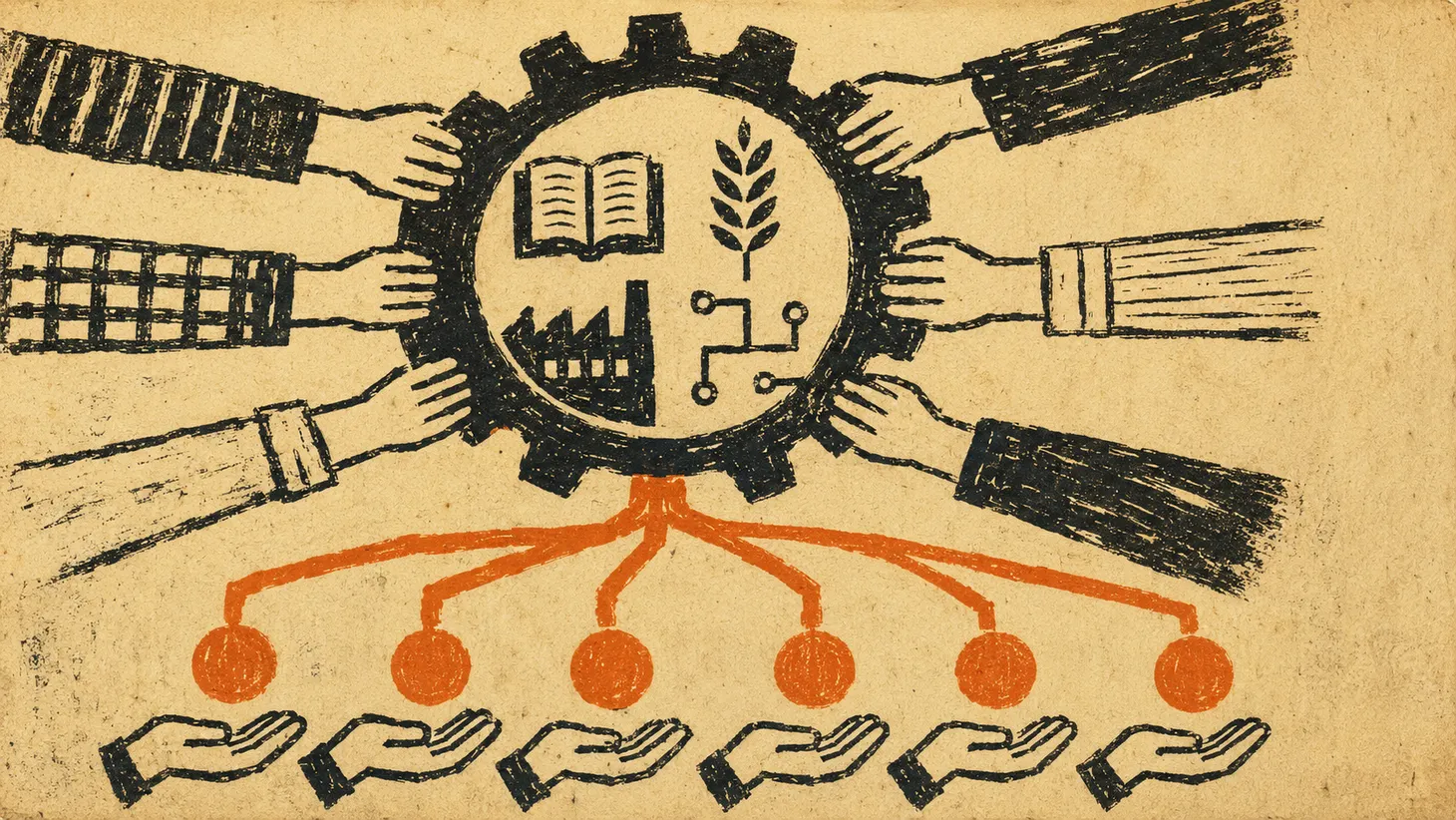
How Do We Pay for Universal Basic Income? Tax Stock the Way Companies Already Issue It.

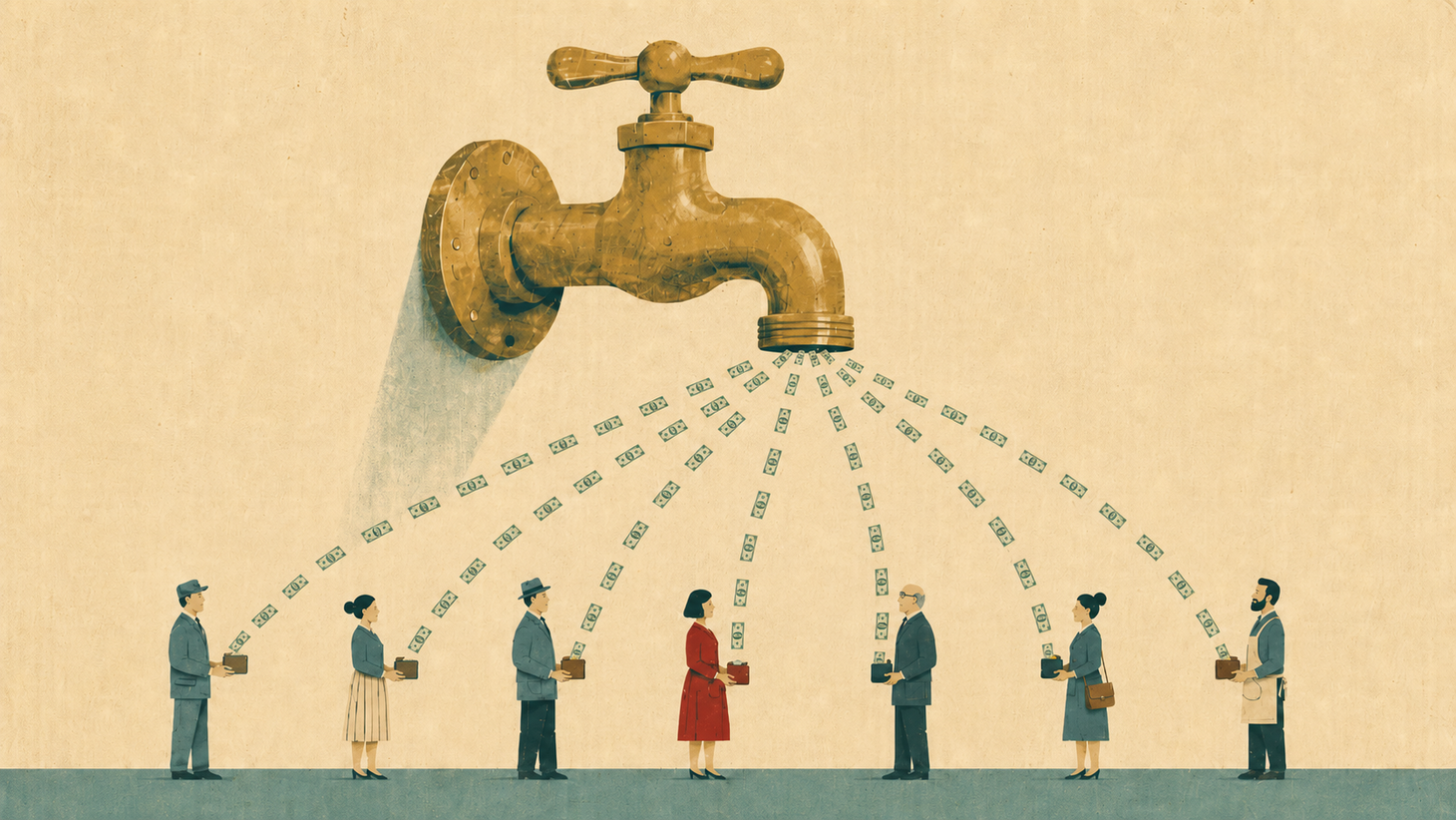
A 1.5% annual stock dilution tax on corporations with revenue over $100M would raise over $1.4 trillion a year — enough to send every American about $365 a month, automatically.
Corporations issue new stock all the time — to raise cash, to pay executives, to swallow up other companies. So here’s a question: what if they had to issue a little new stock to the rest of us, too? I call it a stock dilution tax, and I think it’s the cleanest way to pay for a universal basic income (UBI) with a wealth tax. Make every large corporation mint 1.5% in fresh shares each year, sell them off slowly, and hand the proceeds to every American — roughly $365 a month, with no new bureaucracy and nowhere for the wealthy to hide from it.
I’m not the only one thinking about this approach. This week, Senator Bernie Sanders announced the American AI Sovereign Wealth Fund Act, which would hit the biggest AI companies with a one-time 50% tax to be paid in stock and to drop those shares into a fund that pays dividends to all of us. Last year, Trump signed an executive order to create a sovereign wealth fund, and his administration has been grabbing equity along the way — a roughly 10% stake in Intel, a chunk of the rare-earth company MP Materials, a “golden share” in U.S. Steel. And as I write this, senior officials are reportedly in early talks with the big AI companies about having them voluntarily hand the government shares, with a dividend paid to American households floated as one thing to do with the proceeds. Venture capitalist Vinod Khosla floated taking 10% of every public company and pooling it for the people. And back in 2021, Sam Altman proposed almost exactly this in his essay “Moore’s Law for Everything” where he suggested an American Equity Fund capitalized by taxing big companies 2.5% of their market value every year, payable in shares.
So the question is no longer whether the public should own a stake in the wealth we all help create. Experts regardless of party affiliation have basically conceded that point. The question now is how. And on the how, I think everyone is making the same mistake.
They all want to build a giant pile of wealth.
I don’t. I want to build a faucet.
The mechanism: a tax companies pay by printing shares
Here’s the deal. Require every covered business entity — public or private — with either more than $100 million in annual revenue or more than $100 million in fair-market equity value to issue new shares or equivalent ownership interests equal to 1.5% of its value each year into a public dividend fund. The revenue threshold captures the roughly 35,000 large U.S. firms that can be measured from Census business data, while the valuation threshold prevents high-value private firms from escaping merely because they have low current revenue or stay private. At today’s valuations, that’s around $1.44 trillion a year. Divide it across every legal permanent resident, adult and child, and you get roughly $365 a month, for everyone, permanently, in a way that grows as the value of America’s corporations grows.
Notice what each company actually does to pay this tax. It doesn’t write a check. It doesn’t sell a factory. It simply issues new shares, the same way a government issues new currency. A company that’s worth $100 billion issues $1.5 billion in fresh stock and the public now owns it.
It’s the most painless wealth tax ever designed, and it’s also the most inescapable one ever designed. Think about what dilution does. When you mint 1.5% more shares, every existing share is now worth a hair less, because each one represents a slightly smaller slice of the same company. It’s inflation, but for stocks instead of dollars. And here’s the best part: there is no escaping it. Billionaires can move to Monaco. They can hire the cleverest tax lawyers on Earth. They can route their fortunes through a dozen shell companies in a dozen countries. None of it matters. Their shares are worth slightly less no matter where they happen to sit, because there are simply more of those shares in the world now. You cannot flee dilution. You cannot deduct it. You cannot offshore it. It finds you wherever you are.
And it’s gentle. At 1.5% dilution, the very wealthy don’t lose wealth — they just gain it a little more slowly. Instead of their fortunes compounding at, say, 10% a year, maybe they compound at 8.5%. They still get richer. They just share a sliver of the upside with the rest of us on the way up. I think that’s a deal almost anyone can live with, including them.
My twist: don’t hoard the shares — sell them, steadily, and refill every year
This is where I part ways with Bernie and Trump and Altman and Khosla — and with Matt Bruenig, whose Social Wealth Fund for America is the most carefully worked-out version of the whole idea. Every one of their proposals ends with a giant pile of stock sitting in a government fund, like Norway’s, or Alaska’s, growing over time while it pays out a small percentage of its total value each year. Alaska’s Permanent Fund pays residents a dividend from only a small slice of its holdings, precisely so the fund keeps growing. That’s a fine model if your goal is to hoard wealth.
But why would we want to hoard public wealth? The whole problem is the hoarding. The answer can’t be another hoard.
I’ve written a book about how money actually works for a country that issues its own currency, and the short version is this: the United States does not need to stockpile money before it can spend money. It is not a household. It creates dollars when it spends and deletes them when it taxes. So there is no reason — none — for a vast hoard of wealth at the federal level when we could be putting it directly into people’s hands. A hoard is what you build when you’re afraid you’ll run out. A currency issuer never runs out.
So here’s what I’d do instead. Call it a temporary holding fund — a faucet, not a hoard.
A company issues its shares into the fund. There are about 250 trading days in a year. Each day, the fund sells 1/250th of those shares. And it doesn’t dump them all at the opening bell — it sells them at a slow, steady drip across each trading day, the way an algorithm quietly works a large order so it doesn’t move the price. The goal is to be the most boring participant in the market: to sell every single share over the course of the year so smoothly that nobody can even tell. Then, the next year, the companies refill the fund, and we do it all again.
The proceeds get paid out to every American as The Great American Dividend. We could call the law that creates it the “GAINS Act” — Granting Americans Income from National Shares. We wouldn’t hoard the gains. We’d share them. We wouldn’t invest the gains in the markets. We’d invest them in each other.
To make the system simple, payments would be based on the previous year’s realized proceeds. On January 1, covered companies would issue shares or equivalent ownership interests into a public dividend fund. Over the course of that year, the fund would gradually convert those assets into cash. Then, the following year, the realized proceeds would be paid out in equal monthly checks. That means the 2028 dividend would be funded by the equity collected and sold in 2027, while the 2028 equity batch would be collected and sold to fund 2029. No guesswork. No monthly market swings. Just last year’s shared corporate wealth becoming this year’s monthly public dividend.
“But won’t selling stock every single day crater the market?” That’s a fair question to ask, and the answer is no. The reason why is the whole point of the daily drip. Markets get hurt by surprise and by size: a sudden dump nobody saw coming. A slow, fully predictable, evenly spaced sale of a known quantity is the opposite of that. It’s the most digestible kind of selling there is. And here’s the part that should settle that worry completely: we already run this exact machine in reverse, every single year.
American corporations currently spend more than a trillion dollars a year buying back their own stock — about $1.1 trillion in 2025, an all-time record — removing shares from the market and funneling the gains to the people who already own them. My dilution tax is simply buybacks run backward. Instead of companies pulling shares out to further enrich existing shareholders, we sell shares to enrich everyone. If the market can swallow a trillion dollars of share buying a year, it can absorb a comparable amount of share selling the same way. There's one honest difference — buybacks nudge prices up, and selling nudges them down — but the daily drip keeps that nudge faint, and much of the time we'd simply be offsetting buybacks already underway.
And there's one more advantage I care about. Because the fund sells everything it receives, it never builds up a permanent stake in anybody. The government does not slowly accumulate voting shares and board seats and the power to punish or reward. Bernie and I want a lot of the same things here — broad public ownership of the wealth we all helped build, the rich paying in, everyone collecting a dividend — and his version is sincere about all of it. I just don't want the state holding the controls, and the reason is sitting right in front of us: Trump's administration has been grabbing equity selectively, picking which companies get a federal partner and which don't. That's the danger with state-held shares. The same machinery one administration builds to do good, the next one inherits to reward friends and punish enemies. There's a second danger, too: a government that owns shares in companies it also regulates becomes both shareholder and referee — the very objection critics are already raising. A fund that sells everything is never the lasting shareholder, so it never compromises the referee. So I'd rather the public own the wealth without the government owning the control. My approach is a wealth fund that hoards nothing and controls nothing. A wealth fund that never becomes a power grab.
Thank you to all my monthly patrons who contribute to making my articles free for all. If you find value in my writing and would like to support it, please join my Patreon or become a paid subscriber on my Substack.
Why we’ve earned this
You might be thinking: sure, painless and inescapable, but on what grounds do we get to hand ourselves a slice of companies we didn’t build?
On every ground there is.
Start with the research. Almost none of the technology these companies are built on came from the private sector alone, because the riskiest, earliest, least-profitable science is exactly what the market won’t fund. The public funds it. In Jump-Starting America, economists Simon Johnson and Jonathan Gruber lay out how, beginning in 1940, massive public investment — WWII research and then the Space Race panic after Sputnik — built radar, jet engines, digital computers, and eventually the internet that private companies turned into fortunes. Federal R&D spending peaked at around 2% of GDP in 1964. Today it’s about 0.6%. People have no idea how much of the stock market’s wealth was seeded by public money. Every pharmaceutical company on Earth is, in some real sense, standing on a mountain of public-funded basic research. The profits got privatized. The bill got socialized.
Then there’s the new wrinkle: AI. We all trained it. Every search, every post, every photo, every sentence any of us ever wrote online became fuel for these models — uncompensated labor, performed by billions of us, that now powers trillion-dollar companies. That’s why I launched the AI Pledge for Humanity. The people building AI keep telling us that something like UBI will be necessary. Elon Musk says “universal high income” is the best way to deal with AI-driven unemployment, and Google DeepMind’s Demis Hassabis has said much the same. Okay. Now let’s hold them to it. We trained the machines. We funded the science. We deserve to be treated as what we already are: shareholders. And companies issuing stock to be sold in our name is how you actually make us shareholders, instead of just promising to.
Turning it up
$365 a month as a universal dividend is a real floor, but it’s a starting point, not a ceiling. There are ways to make it bigger.
First, raise the dilution rate. Because the faucet pays out everything it collects, the math here is simple: the UBI rises in a straight line with the rate. Every extra half a percentage point adds roughly $122 a month to everyone’s check. At 2% it’s about $487 a month per person. At 2.5% — the rate Sam Altman himself proposed — it’s around $608. At 3%, about $730. There’s no hidden cliff, no point where collecting more quietly starts collecting less. You just turn the dial.
So why not crank it to 3% on day one? Because the smart move I think is to just get it going. I’d launch at 1.5%, prove the mechanism works, and get checks into people’s hands, because once a UBI exists, raising it becomes one of the most popular votes in all of politics. Then I’d crank it to 2.5% over a few years, and treat 3% as the ambitious ceiling we reach only once the system is mature. And remember, this is an inescapable wealth tax. Elon’s shares are worth slightly less the instant we mint more of them, and he can’t run from it. It’s so much easier than chasing his assets around the globe with auditors. We don’t have to hunt down his wealth. We just have to dilute it.
Second, I like the idea of pairing the dilution tax with a value-added tax of 10% or a tiny tax on all financial transactions — something like 0.25%, in the spirit of what economists call a Tobin tax. This barely touches an ordinary person who buys and holds, but it bites the high-frequency traders who make their money off astronomical volumes of trades. It would tax the churn at the top and, as a bonus, nudge everyone toward investing for the long term instead of skimming pennies off millions of trades a second. I see it as an optional add-on for a larger UBI.
And then there’s what I’ve argued for elsewhere: replacing the standard deduction with a refundable standard credit. Stack that on top of the dilution dividend and the consumption dividend, and a $100/ton carbon fee and 1% land value tax and we’d be talking about a poverty-eliminating multi-layered UBI exceeding $1,500 a month — over $3,000 a month for a couple and over $6,000 a month for a family of four.
But won’t this shrink my 401(k)?
Here’s the objection that deserves the most honest answer of all, because it’s the one that will worry regular people rather than billionaires. If we dilute every company’s shares, we dilute the shares sitting in our retirement accounts. That’s true. So let’s walk through exactly what it does to us — because once you see the math, the worry should evaporate.
Start with what your 401(k) is actually made of (if you even have one). Almost nobody holds 100% stocks for a lifetime. A typical retirement plan lands somewhere around a 60/40 mix — roughly 60% stocks, 40% bonds. So the drag on your account isn’t the headline rate. It’s about 60% of it. At a 2.5% dilution, a typical account grows roughly 1.5% a year slower than it otherwise would have. At the 1.5% launch rate, under 1% slower. Real, but a long way from scary.
Now the part that matters most, and it’s a matter of simple arithmetic. The dilution cost is proportional — it scales with how much stock you own, so a small saver barely feels it while a large one feels it a lot. But the UBI is flat — the same dollar amount lands in every account, whether you’ve saved millions or nothing. Proportional cost, flat benefit. That means there is a crossover point: below it, your monthly check exceeds your loss, and above it, the loss exceeds the check.
So where does the line fall? Run the numbers and it sits at roughly half a million dollars per person. And here’s the best part — it doesn’t move when you change the rate. Crank the dilution from 1.5% to 3% and the hit your retirement account takes gets bigger, yes, but so does your dividend, so the crossover stays put right around $500,000. No matter how high you set the dial, the same group of people are the only ones who end up net contributors. Raising the rate doesn’t really shift who comes out ahead or behind. It only deepens how much the very top shares with everyone else.
So how many people end up with less in retirement? And who sits above that line? Hardly anybody. Only about 9% of households that have any retirement account at all hold $500,000 or more, and since barely half of U.S. households have a retirement account in the first place, that’s only around 5% of all households. The richest 5 to 10 percent. Everyone else — the overwhelming majority of us — comes out ahead.
It’s even better for couples, because the UBI is paid per person while the savings usually aren’t. In most two-earner households, the bulk of the retirement money sits concentrated in one person’s account, yet both people collect the dividend. Two checks against one diluted nest egg pushes the household crossover up close to a full million dollars. A retired couple sitting on almost a million dollars still comes out ahead. Two basic incomes, every month, for the rest of both their lives, easily outrun the slightly slower growth on their savings.
In summary, a slightly smaller nest egg plus a universal dividend beats a slightly larger nest egg and no universal dividend, for roughly 9 out of 10 of us. The only people who’d be modestly worse off are the households least likely to need the help, the ones already sitting on seven figures.
What we should actually want
Decades ago, the writer Robert Anton Wilson described something he called the RICH Economy — Rising Income through Cybernetic Homeostasis. The idea was that automation shouldn’t be something we dread. It should be something we cheer for, because the machines doing more of the work means more abundance for everyone, paid out as a dividend to all. That’s the world I want. I want our companies to win. I want the robots to work for us and the AI to make productivity charts go up, up, up.
But right now, none of that helps you unless you happen to own a lot of stock. The stock market and the economic security of ordinary Americans have come completely uncoupled from each other. The market hits record highs in the same week that families can’t cover an emergency. The productivity belongs to the machines. The gains belong to the shareholders. And most of us are neither.
The stock dilution tax couples those two things back together. It makes every American a shareholder, automatically, by birthright, in the success of the whole economy — so that when our companies do better, we all do better. Not metaphorically. Literally, in dollars, every month. We get to want them to succeed because their success is finally our success too.
We helped pay for the science. We trained the AI. We are the customers, the data, the workforce, and the reason any of it has any value at all. The wealth was built on a foundation all of us laid, going back generations. Our dividend is not charity, and it’s not radical. It’s ours, and it’s overdue.
Let’s not build a giant pile of stocks. Let’s build the faucet — and finally turn it on.
If reading this was worth your time, it’s worth sharing with others. Share it, subscribe for free, and if you can, make a monthly pledge to keep this work going.

Thank you to my UBI Producer level patrons and paid Substack subscribers: Gisele Huff, Steven Grimm, Bob Weishaar, Judith Bliss, Lowell Aronoff, Jessica Chew, Katie Moussouris, Tricia Garrett, A.W.R., Oliver Bestwalter, Daryl Smith, Larry Cohen, John Steinberger, Philip Rosedale, Frederick Weber, Tom Cooper, Joanna Zarach, Mgmuyy, Albert Wenger, Jeremy Wertheimer, Andrew Yang, Kimi Araya, Peter T Knight, Michael Finney, David Innen, Paradigm shift, Miki Phagan, Draper Kauffman, Walter Schaerer, Elizabeth Corker, Albert Daniel Brockman, Joe Ballou, Arjun Banker, Christine Celli, Felix Ling, Jocelyn Hockings, Mark Donovan, Steve Roth, Chuck Cordes, Mark Broadgate, Leslie Kausch, centuryfalcon64, Deanna McHugh, John Sullivan, Stephen Castro-Starkey, CodyS, chris heinz, Zachary Weaver, bradzone, Tim, Warren J Polk, Jeffrey Emmett, Nicolas Pouillard, Eric Skiff, Thomas Welsh, Karla Hagemeister, Mark Pierce, Fred Weber, Linda Hearne, David Allen, Janos Abel, Wendy Voahangy Ravano, Liz, and all my other monthly patrons for their support.
Do you support UBI as an AI dividend? If so, have you signed the AI Pledge for Humanity yet?
UBI Guide Newsletter
Join the newsletter to receive the latest updates in your inbox.