Replace the Standard Deduction With $375 a Month for Everyone

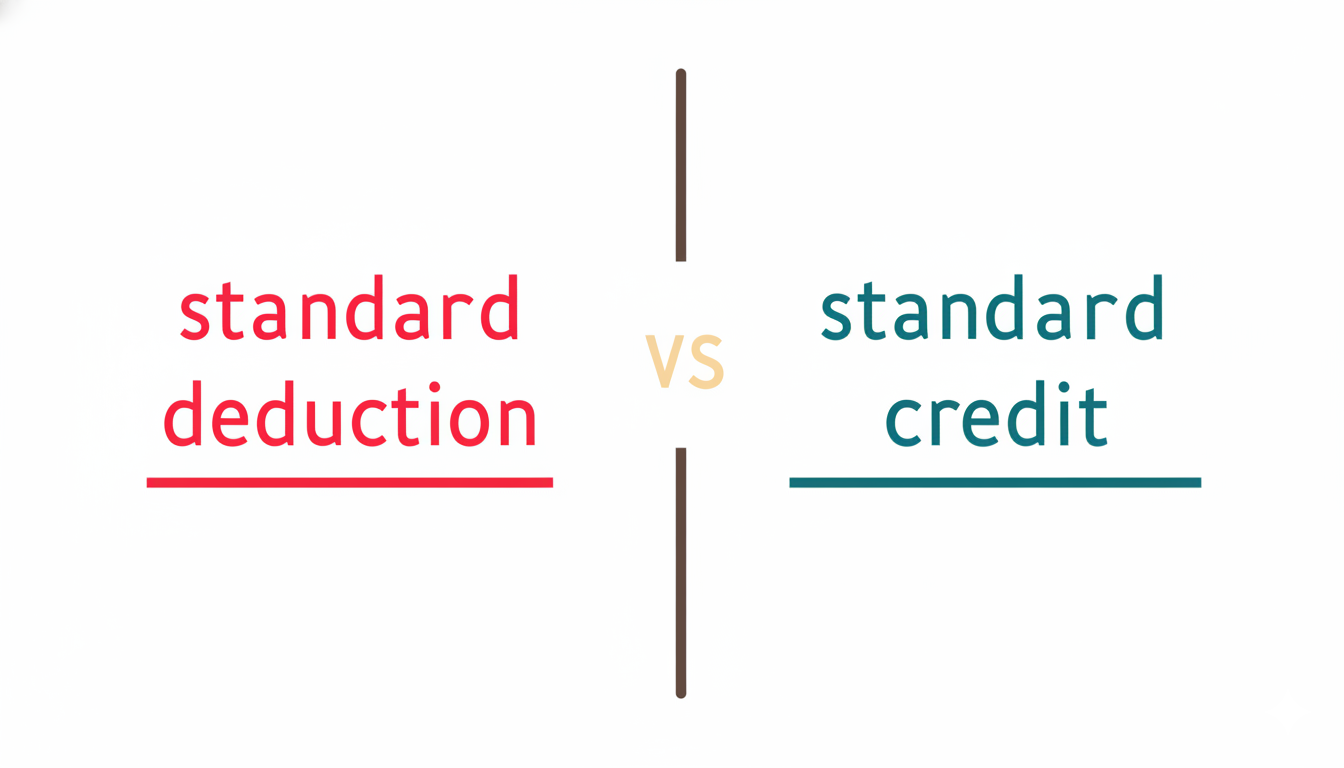
My proposal for a fully refundable $4,500 tax credit that reaches everyone—and leaves the bottom 90% better off
There is a new trend in Democratic politics, and it is one of the most frustrating things I’ve watched in years.
Senator Cory Booker wants to more than double the standard deduction to $75,000 for married couples. Senator Chris Van Hollen wants to exempt the first $46,000 in income from federal taxes. Katie Porter, running for governor of California, wants to exempt the first $100,000 from state income taxes. This is what passes for Democratic economic policy in 2026: a bidding war over who can shield the most income from taxation.
I get the political instinct. Republicans passed their “One Big Beautiful Bill” full of tax giveaways, and Democrats want to show they can cut taxes too. But this is the same strategic error Kamala Harris made in 2024 when she tried to out-tough Republicans on immigration instead of making the affirmative case for what immigrants contribute to this country. When you play on your opponent’s field, you lose, even when you win.
Taxes are not the enemy. Taxes serve vital functions. The question should never be whether to tax, but what to tax and how to make sure the prosperity we create together actually reaches the people who create it. On that question, Democrats are reaching for the wrong tool.
The right tool is not a bigger deduction. It’s a fully refundable tax credit.
Deductions Help the Rich More Than the Poor. That’s How They Work.
A tax deduction reduces your taxable income. That sounds equal if everyone gets the same deduction, but it’s not. The value of a deduction depends entirely on your tax bracket, which means it’s worth more to those who already have more.
Consider the current standard deduction of $16,100 for a single filer. A worker earning $30,000 is in the 12% bracket. That deduction saves them $1,932. A worker earning $200,000 has income reaching into the 24% and 32% brackets. That same deduction saves them over $4,000. The identical provision in the tax code delivers twice as much benefit to the person who needs it less.
Now consider someone earning $12,000 a year — a part-time worker, a caregiver piecing together hours. The standard deduction zeroes out their small tax bill, but that’s all it can do. It cannot put a single dollar in their pocket. A deduction can only reduce what you owe. It can never give you cash.
This is the fatal flaw in every plan built around expanding the standard deduction. Booker’s plan to raise it to $75,000 for married couples would deliver about $10,000 in annual tax savings to a couple earning $300,000, according to the calculator on his own website. A family earning $20,000? Nothing. The poorest 20% of households would see zero benefit from Van Hollen’s plan because their federal tax liability is already zero.
You cannot fight poverty with a tool that is invisible to poor people, and you cannot reduce inequality with a tool that helps the rich more than the working class.
A big thanks to my monthly patrons who contribute to making my articles possible and free for all. If you find value in my writing and would like to support it, please join my Patreon or become a paid subscriber on my Substack.
A Tax Credit Does What a Deduction Cannot
A tax credit reduces your tax bill dollar-for-dollar. If the credit is $4,500 and you owe $5,000 in taxes, you now owe just $500. Everyone gets the same amount of reduction, regardless of their bracket. Simple. Fair. Equality before the law.
But the real power unlocks when the credit is fully refundable. A fully refundable credit means that if you owe $1,000 in taxes and the credit is $4,500, you don’t just zero out your tax bill — you receive $3,500 as a cash payment. The credit reaches below the tax line into the population that deductions can’t touch: the people in poverty.
We know this works because we already proved it.
In 2021, the American Rescue Plan expanded the Child Tax Credit to up to $3,600 per child and made it fully refundable — meaning families previously excluded because they earned too little could receive the full amount. According to Census data, the expansion contributed to a more than 40% reduction in child poverty, driving the rate to a historic low. The CTC lifted 3 million children out of poverty. Full refundability was the main driver, bringing 19 million more children into eligibility.
When Congress let the expansion expire, child poverty more than doubled.
That single year of data is all the proof anyone should need that the mechanism works. The question is whether Democrats have the vision to apply it more broadly.
The Standard Tax Credit: What Democrats Should Actually Propose
Here is what I believe Democrats should do. Replace the standard deduction with a fully refundable Standard Tax Credit — the STC — of $375 per month for every adult and every child, or $4,500 per year per person. Design it the same way the 2021 expanded CTC was designed: anyone can choose to receive the credit as an advance monthly payment, or claim it as a lump sum at tax time.
Like the current standard deduction, the STC is an alternative to itemizing. Filers choose one or the other — not both. Households with high mortgage interest, charitable giving, or state and local taxes can still itemize if that produces a better result for them (although these could also be converted to credits). Everyone else takes the STC, which for the vast majority of Americans will be the far better deal.
This single reform replaces and consolidates the standard deduction, CTC, EITC, WIC, and TANF — converting multiple cash programs into one. No applications. No caseworkers. No benefit cliffs that punish you for taking a raise. Because the credit goes to every adult and every child, a married couple with two children receives $1,500 per month, or $18,000 per year — more than or equal to the combined value of the programs the STC replaces for virtually all households, with a hold-harmless provision ensuring no family receives less than they do today.
Keep the current tax brackets in place for everyone earning under $250k — today’s 10%, 12%, 22%, 24%, and 32% rates. Then raise the existing 35% bracket (currently starting at $250,525 for singles and $501,050 for married couples) to 37%, raise the existing 37% bracket (currently starting at $640,600 and $768,700) to 40%, and add one new bracket on top: 50% on income above $1 million ($2 million for couples). Tax capital gains and dividends the same as ordinary income under these brackets — no more preferential rates that let billionaires pay a lower effective rate than their secretaries. The STC replaces the standard deduction as the primary mechanism for reducing taxes on the overwhelming majority of Americans, and the new top brackets raise taxes at the top to help balance it out.
The credit is what makes the system progressive at the bottom. Because it's a flat amount, $4,500 represents a much larger share of income for a low earner than a high one — and because it's fully refundable, it reaches the people deductions can’t. The brackets handle fairness at the top. The credit handles it at the bottom and middle.
Who Pays More. Who Pays Less.
Under this system, the bottom 90% of Americans are taxed less than they are now. A single filer earning $12,000 goes from owing nothing (and getting nothing) to receiving a net refund of about $3,300. At $30,000, they save $2,568. At $50,000, they save $2,416. At $100,000, they save $958. At $150,000, they save $636. At $200,000, they save $420.
For married couples with two credits, the savings are even larger. A couple earning $40,000 saves $5,457. At $100,000, they save $4,831. At $200,000, they save $1,916. At $400,000, they still save $840. Add children — each receiving their own $375 per month — and the savings grow further.
The crossover — the income at which the new system taxes someone more than the current one — lands at around $206k for single filers and $412k for married couples, roughly the top 5% to 10% of each group. A single filer at $300k pays about $2,124 more per year. A single filer at $500k pays about $6,124 more. A couple at $700k pays about $6,249 more. These amounts represent modest fractions of incomes that will increasingly be the product of AI-augmented productivity — income flowing disproportionately to those capturing the gains from technologies we all helped train.
Then the new top brackets kick in. A single filer at $900,000 pays about $17,000 more once the 37→40 rate change takes effect. At $1.5 million, $85,000 more once the 50% bracket takes over. At $5 million, over $540,000 more. Taxing capital gains as ordinary income ensures that the wealthiest — whose income is disproportionately derived from investments rather than wages — contribute their fair share. Add a wealth tax of 1% above $50 million, 2% above $1 billion, and 3% above $10 billion, and the wealthiest finally begin paying their fair share in taxes.
The bottom 90% see their tax burden go down. The next 9% see small increases — typically less than 1% of their income. The top 1% sees substantial increases. The top 0.1% sees the largest increases. This is progressive taxation that reduces the economic inequality of this Second Gilded Age.
How to Pay for It
The cost of a $375/month standard credit replacing the standard deduction is approximately $1 trillion a year. Here are the other tax offsets:
- Consolidating existing programs — CTC ($120 billion), EITC ($75 billion), WIC ($7 billion), and TANF ($17 billion) — recovers ~$220 billion.
- The new top brackets — raising the existing 35% rate to 37%, the existing 37% rate to 40%, and adding a new 50% bracket above $1 million ($2 million for couples) — approximately $135 billion.
- Taxing capital gains and dividends as ordinary income raises a conservatively estimated $150 billion to an optimistic $220 billion.
- The wealth tax adds another $240 billion or more.
Total revenue: approximately $745 billion to $815 billion. That leaves a gross annual deficit of roughly $245B to $315B. But that shortfall does not account for what happens when you give money to people who spend it.
A Credit Grows the Economy. The Deficit Pays for Itself.
When low- and middle-income households have cash, they spend it. The USDA estimates that every dollar of SNAP generates $1.50 to $1.80 in GDP. Canada’s Child Benefit generates $2 per $1 while recovering over 55 cents per dollar in taxes from the resulting economic boost. A larger standard deduction disproportionately benefits higher earners who save the windfall. A refundable credit puts money in the hands of immediate spenders. That spending is revenue for businesses. That revenue creates jobs. The economy grows from the bottom up.
Calnitsky and Gonalons-Pons analyzed the Dauphin Mincome experiment and found significant reductions in both total crime and violent crime when residents received guaranteed basic income. Scaled conservatively for the smaller poverty-reduction effect of a $375/month credit relative to Dauphin’s near-elimination of poverty, the total societal benefit of the resulting crime reduction is approximately $300 to $500 billion per year — roughly $75 billion of which translates into direct federal budget savings through reduced criminal justice spending, lower Medicaid costs from violent-crime injuries, and recovered tax revenue from people who were not victimized. Evelyn Forget’s analysis of the same experiment documented an 8.5% reduction in hospitalization rates from fewer accidents, injuries, and mental health admissions. Applied to the roughly $620 billion Medicaid and Medicare spend on hospital care, that’s another $53 billion saved. GDP multiplier effects generate approximately $200 billion in additional tax revenue.
Those three offsets total $328 billion — more than the estimated deficit. The plan therefore runs a net annual surplus of roughly $13 to $83 billion in its first year. And those are just first-year, federally-relevant effects. Research led by Irwin Garfinkel at Columbia University estimates that the children’s portion of the credit alone would generate trillions in present-value annual societal returns through higher future earnings, better health, and reduced long-term government spending — a potential 15-to-1 return on investment per child. This is not a costly proposal. It is a plan that pays for itself, even before counting the massive generational benefits to children and the country they will inherit.
This Is Universal Basic Income. Call It What It Is.
What I’m describing is a small universal basic income delivered through the tax code. A fully refundable tax credit paid to every person, monthly, with no conditions — that is UBI. The political scientist Philippe Van Parijs explained years ago why universality is essential even when it seems counterintuitive to include the rich. Giving money to everyone, even the rich, is not better for the rich but better for the poor. The high earners pay for their own credit and more. Universality makes it much harder for the poor to be excluded or fall through the cracks. Those just below income cutoffs are no longer trapped by the threat of losing means-tested benefits if they find a job. And a universal transfer does not stigmatize the poor the way a targeted one does.
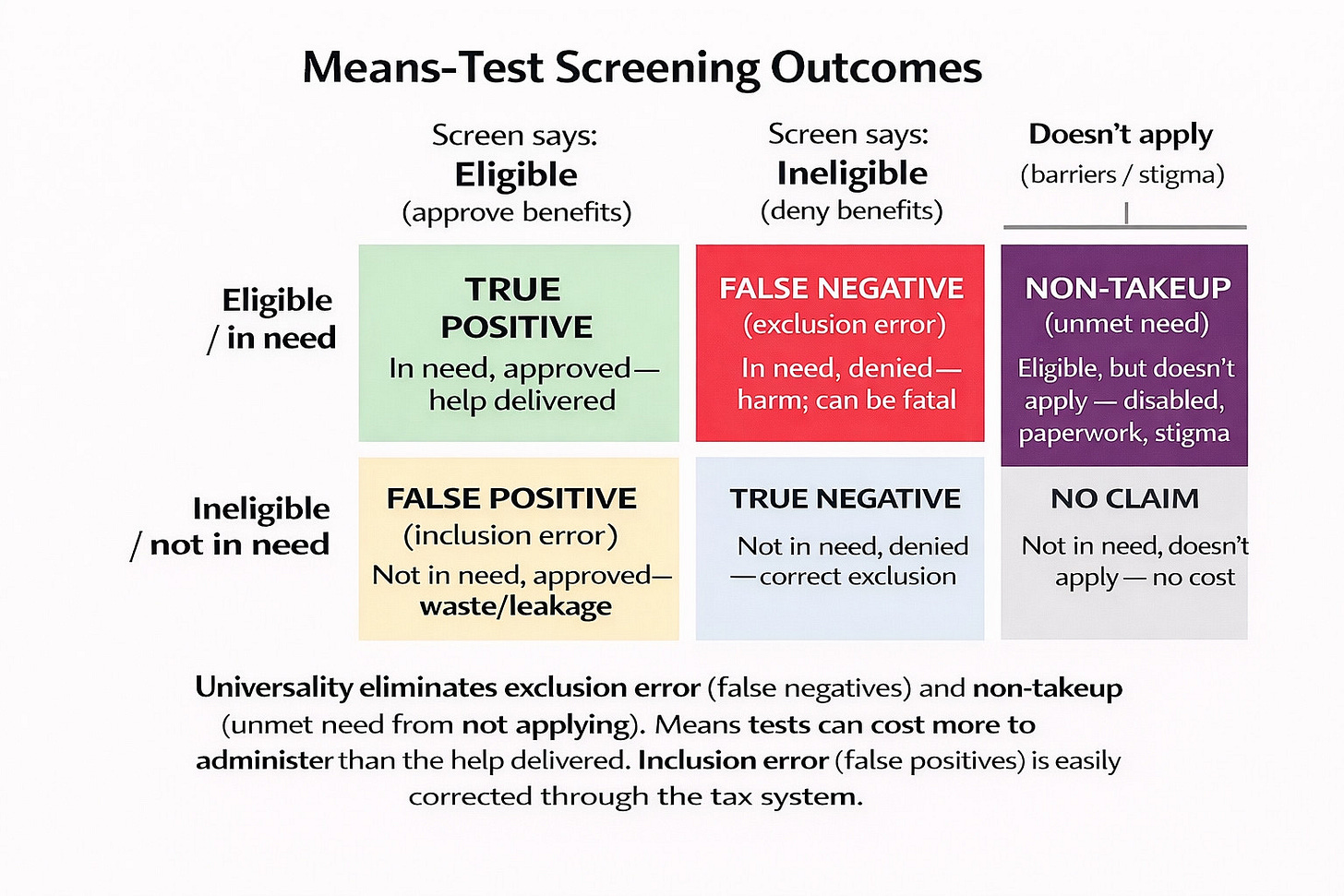
Van Parijs also offered a critical insight: sometimes the best way to achieve a basic income is to present it as a refundable tax credit — simply reducing taxation for everyone, with a cash transfer to those whose tax liability is less than the credit. That is exactly what this proposal does. It is UBI, implemented through the mechanism Americans already understand and accept.
“But Won’t People Stop Working?” No.
The most common objection to UBI is that it will discourage work. The evidence says otherwise — and at $375 per month, the question barely makes sense. $375 is not enough to live on. It is not enough to pay rent in any major American city. It is enough to pay for food, take the edge off, cover a car repair, keep the lights on during a bad month. It is a foundation, not a net full of holes. It’s a floor, not a ceiling.
Unconditional income experiments of $500 to $1,000 per month have not shown people leaving the workforce in any worrisome way. Plenty have shown increases. Alaska, which has paid every resident an annual dividend since 1982, saw increased employment. Their similar size UBI — which could be $3,800 this year — has had no negative impact on full-time work and a 17% increase in part-time work, as cash recipients generated more demand that local businesses had to hire more workers to meet.
But the most relevant evidence is what happened here in 2021. About 40 million American families received monthly Child Tax Credit payments of $250 to $300 per child — approximately the scale of a $375 Standard Tax Credit, through the same delivery mechanism, to the population that would benefit most under this proposal. Parents kept working. Employment among parents actually went up slightly. And economists who studied the impact found no measurable inflationary effect from the CTC payments — the inflation that did occur was driven by global supply chains and oil shocks, not by families receiving cash. The Standard Tax Credit has, in essence, already had a massive trial experiment. It worked.
A Foundation, Not a Ceiling
For those on the other side — those who think $375 per month is too low — I agree. It is. $375 is a starting point, not an end point. The Standard Tax Credit is the foundational layer of a UBI that can grow as additional tax mechanisms are added on top. Each layer is a separate income stream feeding the same monthly delivery mechanism. Some illustrative possibilities:
- A 10% value-added tax could raise roughly $1.76 trillion per year. Split 2:1 between adults and children — recognizing adults consume more — that adds about $487/mo per adult and $243/mo per child.
- A 1% land value tax would likely equate to about $200B–$400B annually, with ~$300B as a midpoint estimate based on current rough land value ranges. With the same 2:1 split, that adds about $100/mo per adult and $50/mo per child. I recommend raising this to 5% over the course of 5-10 years, which would raise the amounts to $500/mo per adult and $250/mo per kid and grow as land value grows.
- A 1.5% stock dilution tax requiring the roughly 35,000 corporations valued over $100 million to issue 1.5% new stock each year into a national wealth fund — sold gradually over the following year through normal trading — could generate around $1.4 trillion. Distributed as a productivity dividend, that adds about $365/mo per adult and child, or about $400/mo per adult and $200/mo per child that would grow as the stock market grows.
- A $100-per-ton carbon tax on the roughly 5 billion tons of US emissions could raise about $500 billion, adding another $125/mo per person.
- A tax on intellectual property rents — applying to royalties, licensing income, and excess profits from patents and copyrights — could raise roughly $200 billion per year, adding about $60/mo per adult and $30/mo per child.
Stack all of those layers on top of the $375 Standard Tax Credit, and the total reaches around $2,000/mo per adult and over $1,200/mo per child — a full-on basic income floor well above the $1,350/mo 2026 federal poverty line. The child amount would cover about 90% of the median cost of raising a child to an adult. Each layer stands on its own merits: the VAT taxes consumption instead of income in the AI Age, the LVT taxes land and increases the housing supply, the stock issuance tax shares national productivity gains that haven’t been shared since the mid-1970s, the carbon tax reduces pollution and incentivizes clean energy, and the IP tax captures economic rent and expands the public domain. The details of each are for other articles and there can be any number of more layers. The point is that the Standard Tax Credit is the base layer that reduces the income taxes of the bottom 90% of Americans. Everything else can build on top of it.
Closing the Deal
“$375 a month for every American” is a clearer, more compelling, more memorable message than “We’ll raise the standard deduction to $75,000.” One is concrete. The other is accounting jargon. One reaches every single person. The other reaches only those with enough income to benefit — and gives more to those who already have more. Democrats don’t need to become the party of not taxing. They need to become the party that leaves more money in 9 out of 10 people’s pockets after taxing. That is not a tax deduction. That is a dividend on being American.
Stop bidding up the standard deduction. Start fighting for the Standard Tax Credit.
If reading this was worth your time, it’s worth sharing. Share it, subscribe for free, and if you can, make a monthly pledge to keep this work going.

Thank you to my UBI Producer level patrons: Gisele Huff, Steven Grimm, Bob Weishaar, Judith Bliss, Lowell Aronoff, Jessica Chew, Katie Moussouris, Tricia Garrett, A.W.R., Daryl Smith, Larry Cohen, John Steinberger, Philip Rosedale, Liya Brook, Frederick Weber, Dylan Hirsch-Shell, Tom Cooper, Joanna Zarach, Mgmguy, Albert Wenger, Jeremy Wertheimer, Andrew Yang, Kimi Avary, Peter T Knight, Michael Finney, David Ihnen, Janos Abel, Miki Phagan, Draper Kauffman, Walter Schaerer, Elizabeth Corker, Albert Daniel Brockman, Joe Ballou, Arjun Banker, Christine Celli, Felix Ling, Jocelyn Hockings, Mark Donovan, Jason Clark, Chuck Cordes, Mark Broadgate, Leslie Kausch, centuryfalcon64, Deanna McHugh, John Sullivan, Stephen Castro-Starkey, CodyS, chris heinz, Zachary Weaver, bradzone, Tim, Warren J Polk, Jeffrey Emmett, Nicolas Pouillard, Eric Skiff, Thomas Welsh, Linda Hearne, David Allen, Liz, and all my other monthly patrons for their support.


UBI Guide Newsletter
Join the newsletter to receive the latest updates in your inbox.