Turtles All the Way Down: The Biological Case for Universal Basic Income

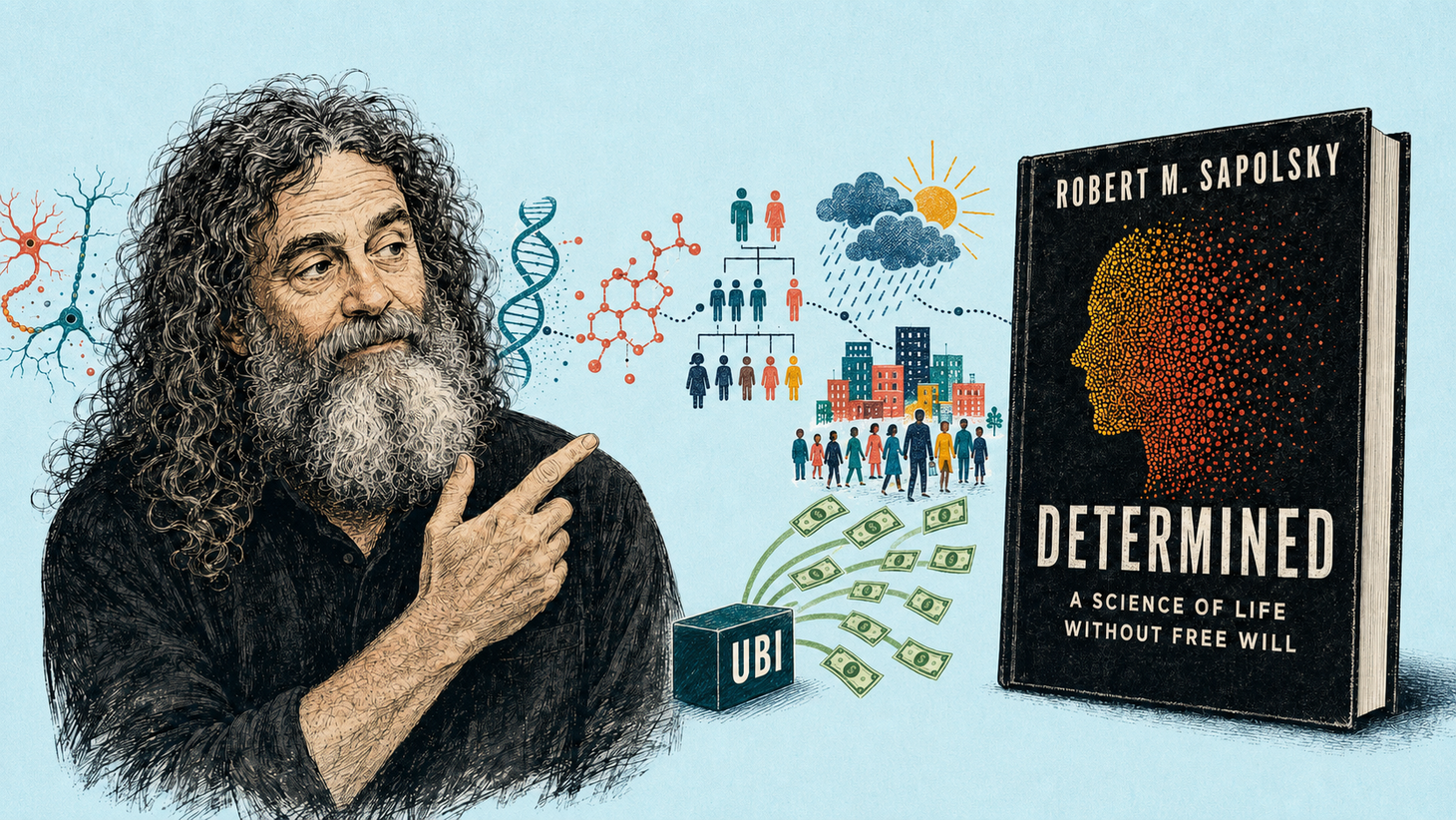
If our decisions are shaped by forces we never chose, then punishing people for those decisions and withholding the resources that would improve them is our true moral failure.
I got my psychology degree in 2004 with a focus on cognitive neuroscience after first spending two years studying engineering physics. That background has informed almost everything I’ve written about basic income, especially when it comes to the science of stress, which I’ve written about previously. But it wasn’t until I recently read Robert Sapolsky’s book Determined: A Science of Life Without Free Will that something newly shifted in how I think about UBI at the most fundamental level as a recognition of what we actually are.
We are not who we think we are. And the implications of that are enormous.
Sapolsky’s book makes the argument that I think for most people is completely unacceptable: there is no free will. Not in the way most people use the term. When you make a decision, that decision is the product of neuronal firing patterns shaped by the seconds before, which were shaped by the minutes before, which were shaped by the hormones of the hours before, which were shaped by the neuroplasticity of the months before, which were shaped by the development of the years before, which were shaped by the genetics and epigenetics baked into you before you ever drew your first breath. It’s causes and effects all the way down. Or as Sapolsky frames it, borrowing from a famous cosmological anecdote: it’s turtles all the way down. There is no turtle floating in the air. There is no moment where the chain of cause and effect breaks and a “you” steps in to freely choose. That’s the illusion.
I know. It’s a lot. Most people won’t accept it. Most people can’t accept it, because the feeling of choosing is so strong that it seems absurd to deny it. I feel it too. I feel like I chose to write this essay. But Sapolsky would argue that I was always going to write this after reading his book, given everything that led to this moment. My reading his words, the neurons it activated, the prior decade of my writing about stress and poverty, my psychology degree, my physics background, my childhood, my mom’s womb, my diet, my inherited mix of genes. All of it. Turtles on turtles on turtles.
So what does this have to do with universal basic income?
I think it might be the most controversial argument for UBI I've ever tried to make.
The Chain of Causation
To understand why, you have to understand the chain of causation. Sapolsky walks readers through it one piece at a time, starting at the moment of a behavior and working backward through every layer that produced it.
A neuron fires and your hand moves. You did something. Why? Because a pattern of neurons in your motor cortex activated. Why did those neurons fire? Because neurons in your prefrontal cortex — the part of your brain involved in decision-making, impulse control, and long-term planning — signaled them to using cascades of neurotransmitters. Why did those neurons fire in that pattern? Keep going.
Seconds to minutes before, your brain was awash in hormones that shaped what those neurons did. Testosterone, for example, doesn’t simply cause aggression the way most people assume. It amplifies whatever behavior is already being rewarded in your social context. In an environment where aggression earns status, testosterone makes you more aggressive. In an environment where generosity earns status, testosterone makes you more generous. Testosterone is a hormone that basically is about status.
Then there’s oxytocin and its close relative vasopressin (our love hormones). Oxytocin enhances mother-infant bonding and pair bonding. It makes people calmer by quieting the amygdala. Boost someone’s oxytocin levels, and they become more charitable and trusting in games of competition. Vasopressin does something similar, strengthening pair bonds and paternal behavior. In rodent species, the difference between a monogamous male who sticks around to raise his kids and a polygamous male who doesn’t, comes down to the density of vasopressin receptors in the reward center of its brain. Increase those receptors artificially, and the polygamous male suddenly becomes a devoted father. But oxytocin doesn’t make you warm and prosocial toward everyone. It makes you warm toward people who count as “Us.” Toward people who count as “Them,” it can actually increase hostility, making you more aggressive toward competitors, more biased against outsiders, even more inclined to gloat over a stranger’s misfortune. And the levels of these hormones you carry, these are shaped by your genes, your fetal environment, and whether you woke up this morning next to someone you care about.
Cortisol, meanwhile (our primary stress hormone) shifts your brain toward short-term survival thinking and away from the kind of measured, long-term reasoning the prefrontal cortex specializes in. You didn’t choose your hormone levels. They helped choose your behavior.
Hours to days before, your brain’s wiring was shaped by sleep, by what you ate, by whether you were sick, by what stressors you’d been exposed to recently. That wiring determines what your prefrontal cortex is even capable of doing in the moment of your “decision.” And here’s a finding that gets at the heart of the UBI argument: the prefrontal cortex (the seat of willpower and “good judgment”) is the brain region most vulnerable to depletion. It is the most metabolically expensive part of the brain. It tires. And when it tires, it works less effectively.
Sapolsky describes a study that illustrates this really well. People who were dieting were placed in front of a bowl of candy. Some of them had just completed a series of demanding cognitive tasks. Others had not. The ones whose frontal cortices had already been taxed by difficult mental work were significantly more likely to break their diets and eat the candy. Their willpower was literally depleted. The cognitive effort of the tasks consumed the neural resources they needed to resist temptation.
Now think about what this means for someone living in poverty. We already know from scarcity research that the mental burden of not having enough financial security operates like a background program consuming processing power. It’s been measured as equivalent to losing roughly 14 IQ points, which is comparable to the cognitive cost of an entire night’s sleep and the difference between “superior” and “average” intelligence, or between “average” and “borderline deficient.” If you’re spending your finite cognitive resources worrying about how to pay rent, how to keep the lights on, how to feed your kids, you have less prefrontal capacity left for everything else. Less capacity for patience. Less capacity for long-term planning. Less capacity to resist that drink, that cigarette, that lottery ticket. Not because you’re weak, but because your brain is already maxed out.
Months to years before, the neuroplasticity of your brain — its ability to rewire itself in response to experience — shaped the actual architecture of your decision-making. Chronic stress doesn’t just make you feel bad. It physically remodels your brain. It enlarges the amygdala, the region that processes fear and threat, while shrinking the hippocampus, the region involved in memory and contextual judgment. A chronically stressed brain becomes a brain that is biologically tuned to perceive threats everywhere and struggle to think its way out of them.
New research published in Innovation in Aging even looks at the impacts of long-term financial insecurity and finds that people who experience persistent money struggles or persistent low income in early and middle adulthood perform less well in cognitive tests by age 53 and show significant brain atrophy by age 71. Increased exposure to low household income and financial hardships was associated with lower cognitive processing speed and, over time, it reduced the amount of brain, particularly in men.
And decades before — during childhood, during fetal development, during the moment of conception when your particular genetic combination was assembled together — the foundations of all of this were laid without any of your choosing.
Older Than Thought
One of the things that struck me most in Determined is how ancient some of this neural machinery actually is. Sapolsky describes the neuronal circuits responsible for something as simple as blinking and traces them back to the sea slug Aplysia. Blinking is one of the oldest circuits in neuroscience, operating on principles that are hundreds of millions of years old. The same basic mechanisms that make a sea slug retract its gill when you poke it are the ones that make your brain associate a sound with a shock, or a smell with a memory, or a face with a feeling. It’s the basis of Pavlovian conditioning.
This is the foundation on which all of our “choices” are built. We like to believe that somewhere above this machinery, there’s a rational agent pulling the levers, but Sapolsky argues that there is no level at which the machinery gives way to something else. It’s neurons running on ancient circuitry all the way up. Even the most sophisticated stuff your prefrontal cortex does — weighing competing options, imagining future consequences, overriding an impulse — is itself a product of neurons operating according to the same physical and chemical laws as everything else.
Conditioned associations can be exploited to create links between things that have no logical connection. You can condition someone to associate an out-group like immigrants with fear. You can condition someone to associate poverty with moral failure. You can condition an entire society to believe that hard work is the primary determinant of success when the data says otherwise. These aren’t rational conclusions. They are conditioned responses, running on the same circuitry a sea slug uses to decide whether to retract its gill when touched. And once conditioned, they are remarkably resistant to logic.
You Are Your Environment
If this chain of cause and effect shapes individual behavior, it also shapes entire cultures, and this is where Sapolsky’s book kind of blew my mind.
Sapolsky describes how something as basic as climate and geography can determine the kind of society you’re born into, which in turn shapes the neural development of every person in it. For example, growing rice requires elaborate irrigation systems and cooperative labor among neighbors. You can’t really grow rice alone. You need to coordinate water usage with the people upstream and downstream. And so, over centuries, rice-based agricultural societies developed cultural orientations toward collectivism, deference, and cooperation. Meanwhile, herding sheep or goats requires rugged self-reliance and a willingness to violently defend your flock from anyone who might take it. And so, over centuries, pastoralist societies therefore developed cultures of honor, independence, and retaliatory aggression.
These aren’t just random cultural tendencies. And they get wired into brains. Research in cultural neuroscience has shown that people raised in collectivist cultures and people raised in individualist cultures actually process information differently at the neural level. Their brains are structurally different because their environments were different. Think about that.
You didn’t choose to be born into a rice culture or a herding culture. You didn’t choose whether your community would wire your brain for cooperation or for vigilant self-protection. But those things shaped who you are, down to the architecture of your neurons.
Now think about what it means to be born into a culture of poverty. A culture of economic insecurity. A culture where chronic stress is as ambient as the air.
The ACE Score and the Dice You Were Handed
Anyone interested in human wellbeing should know about the Adverse Childhood Experiences score. The ACE score is a simple count of how many categories of adverse experiences a person was exposed to during childhood like: physical or emotional abuse, neglect, a household with substance abuse, mental illness, domestic violence, incarceration of a family member, or parental separation.
The relationship between ACE score and life outcomes is one of the most robust in public health. For each additional adverse experience, the risk of negative outcomes climbs. People with high ACE scores are dramatically more likely to become addicted to substances, to develop heart disease, to experience depression and anxiety, to attempt suicide, to end up incarcerated, and to die young. And remember that new study about long-term economic stress and brain atrophy that showed a larger impact in men? It also showed a larger impact for adults with high ACE scores.
Again consider free will. None of these children chose their ACE score. A child doesn’t choose to be abused. A child doesn’t choose to have a parent in prison. A child doesn’t choose to grow up in a home where addiction is the norm. And yet those experiences physically alter the developing brain, changing the trajectory of the entire life that follows. The prefrontal cortex develops differently. The stress response system calibrates differently. Gene expression changes epigenetically in ways that can last a lifetime and even be transmitted across generations.
When that child grows up and makes what we call a “bad decision” by dropping out of school, becoming addicted to something, or committing a crime, we blame them. We say they made a choice. But the neuroscience says their capacity for making what we’d consider the “right” choice was compromised by forces that acted on their brain before they were even old enough to go to school.
When the Disease Undermines the Cure
Sapolsky tells a story in Determined that I think captures this blame problem memorably. A woman with epilepsy was told by multiple doctors not to drive because of the risk of having a seizure behind the wheel. She drove anyway. She had a seizure while driving. She caused an accident that killed a child.
The instinct is to blame and punish her. She knew she had seizures. She was told not to drive. She chose to drive anyway. But Sapolsky points out something that should give us pause: the very same brain abnormality that caused her seizures likely also impaired her judgment about whether to drive. Epilepsy doesn’t just produce seizures. It can affect the frontal regions of the brain involved in risk assessment, impulse control, and decision-making. The disease itself undermines the cognitive capacity needed to properly manage the disease.
This is not an unusual situation. It’s actually the norm for many conditions. Depression impairs the motivation needed to seek treatment for depression. Addiction hijacks the reward circuitry needed to choose sobriety. Poverty depletes the cognitive bandwidth needed to make the financial decisions that might escape poverty. The condition and the capacity to address the condition are entangled. You can’t separate them and pretend that someone is freely choosing to remain in their condition.
Parasites and Vaccines
If you’re still not convinced that our decisions aren’t entirely our own freely chosen, consider Toxoplasma gondii.
This is a single-celled parasite that needs to get inside a cat’s gut to complete its reproductive cycle. To do that, it infects rodents and actually rewires their brains so that instead of being terrified of the smell of cat urine, they become attracted to it. The infected rodent walks toward the cat, the cat eats the rodent, and so the parasite accomplishes its life’s mission. The rodent never “chose” to approach the cat. Its brain was hijacked by a parasite.
Somewhere between a third and half of all humans on Earth are infected with Toxoplasma gondii. In humans, infection has been associated with subtle personality changes like increased risk-taking, slower reaction times, and in some studies, an elevated rate of car accidents and links to conditions like schizophrenia. We are carrying around a parasite that may be quietly nudging our behavior.
And Toxoplasma is just one organism. Your gut is home to trillions of bacteria collectively called the microbiome that are, in a strange and literal sense, part of you and not you at the same time. Did you know that these bacteria produce neurotransmitters? About 90% of the body’s serotonin is manufactured not in the brain but in the gut, by bacteria. Gut microbes also produce dopamine, GABA, and other neurochemicals that directly influence how you feel, what you crave, and how you respond to stress. Research has shown that altering the gut microbiome in mice can change their anxiety levels, their social behavior, and their responses to stress. You are a walking ecosystem. An entire microbial civilization living inside you is participating in the production of the chemistry that underlies your “decisions.” You didn’t choose those microbes. You acquired them from your mother during birth, from your environment, from what you eat. And they are shaping what you do next.
Sapolsky brings up another example that really struck me. During the first Gulf War, U.S. troops were given a drug (pyridostigmine bromide) to protect against chemical weapon exposure. The drug was tested beforehand and deemed safe. But the testing didn’t account for the conditions soldiers would actually face: extreme heat, sleep deprivation, heavy physical loads, and the psychological stress of combat. Under those conditions, the drug interacted with the soldiers’ already-stressed physiology in ways that contributed to what became known as Gulf War syndrome. They now suffer from a cluster of chronic symptoms including fatigue, pain, and cognitive problems.
The drug was safe in the lab but it wasn’t safe in the field because of stress.
This raises a question that applies to far more than war: what else do we think we understand about human behavior, health, and decision-making based on observations made under ideal conditions that don’t account for the chronic stress of real life? Most of what we think we know about willpower, about self-control, about good decision-making — how much of that was studied in people who had their basic needs met, who weren’t worried about rent, who weren’t overflowing with stress hormones? When we judge someone living in poverty for making a decision that a middle-class person in a lab wouldn’t make, we’re comparing results within two very different environments.
From Witches to Patients
All of this leads to the question of where we draw the line between biology and blame.
Sapolsky makes the point in Determined about how in the 15th century, a person who had epileptic seizures stood a real chance of being burned alive as a witch. A handbook for the Inquisition published in 1486 that was used for over 200 years titled Malleus Maleficarum explicitly identified seizures as a sign of demonic possession. Hundreds of thousands of people, mostly women, were killed as a result.
Today, no one burns people with epilepsy. We give them medication. We understand that seizures are a neurological condition, not a moral failing. As Sapolsky puts it, we learned to say a new sentence: “It’s not her; it’s her disease.”
That shift took centuries, but it happened. It happened because our understanding eventually deepened through science. We moved the line of what we consider within a person’s control, and what we consider biology. Sapolsky’s argument is that the history of medicine is really the history of moving that line, and that it has only ever moved in one direction. We used to blame people for things we now understand they couldn’t control. We never move the line the other way though. No one has ever discovered a condition we thought was biological and concluded, “Actually, turns out she’s just a witch after all. Burn her!”
So the question is: where does that line stop? If every new discovery has moved it further from “free choice” and closer to “biological and environmental causation,” why would we assume there’s a line where it finally stops and free will takes over?
I no longer believe we should assume that. And I think the implications for how we view poverty and in turn basic income are pretty profound.
The Just World Fallacy
There’s a name for the belief that people basically get what they deserve. It’s known as the Just World hypothesis. It’s a comforting belief that lets us look at someone who’s struggling and tell ourselves they must have done something to deserve it, and look at someone who’s thriving and tell ourselves they must have done something to earn it.
But the science says otherwise. An Italian simulation I’ve written about before modeled how talent and luck interact and found that pure talent was not the best predictor of success. Luck was. The most successful people in their simulations weren’t the most talented. They were moderately talented people who luckily caught the right breaks at the right moments. And the most effective intervention for ensuring that talent outperforms luck? Giving everyone an equal amount of money. Not rewarding the already successful. Not trying to identify who “deserves” funding. Just giving everyone the same income with the same regularity.
Sapolsky arrives at the same conclusion about luck without modeling. If every decision a person makes is the downstream product of genetics, epigenetics, hormones, childhood experiences, culture, parasites, and environmental stressors — none of which anyone chooses — then the concept of “deserving” collapses. He writes:
“There is no justifiable ‘deserve’. The only possible moral conclusion is that you are no more entitled to have your needs and desires met than is any other human. That there is no human who is less worthy than you to have their well-being considered. You may think otherwise, because you can't conceive of the threads of causality beneath the surface that made you you, because you have the luxury of deciding that effort and self-discipline aren't made of biology, because you have surrounded yourself with people who think the same. But this is where the science has taken us.”
That passage essentially summarizes the book. I have also never read a more concise destruction of the moral framework that sustains opposition to UBI. Every argument against giving people a basic income floor, every “they should just work harder,” every “why should I pay for someone else’s bad choices,” every “some people just don’t want to help themselves;” it all rests on the assumption that there’s a “they” in there who is freely choosing to fail. Sapolsky’s decades of research says there likely just isn’t.
The Biological Argument for UBI
Now let’s bring this all the way back to unconditional basic income.
If our decisions are not truly free but are the downstream products of genetics, epigenetics, hormones, parasites, childhood experiences, cultural conditioning, cognitive depletion, and chronic stress — none of which any individual ever chooses — then the most rational response is not to blame individuals for the outcomes those forces produced. The most rational response is to transform the environment.
This is the argument for UBI that I think may be the most important one I’ve ever tried to make, and it’s the one that arguably runs deepest and is likely the hardest to accept. It’s not the economic argument, though the economics work. It’s not the automation argument, though automation makes it urgent. It’s not even the moral argument, though the morality is clear. It’s the biological argument. The argument that rests on what we actually are, down to our neurons.
If we know that poverty during pregnancy alters fetal brain development through chronic stress and elevated cortisol — and we do — then we should want no one who is pregnant to live in poverty. Not because they “deserve” help. Because the developing brain inside them will be physically changed by the stress, and that child will carry those changes for life. UBI improves prenatal conditions.
If we know that growing up in poverty raises ACE scores, alters gene expression, impairs prefrontal development, and tilts the stress response toward chronic activation — and we do — then we should want no child to grow up in poverty. Not because those children made bad choices. Because they haven’t made any choices. Their neurons are still being wired. UBI improves ACE scores.
If we know that chronic economic insecurity depletes the same cognitive resources needed to make what we’d call “good decisions” in the same way a difficult cognitive task depletes the willpower of someone trying not to eat candy, then we should want no adult to live in chronic financial insecurity. Not because they need to be saved from themselves. Because their decisions are being shaped by a brain under siege. UBI improves cognitive capacity.
UBI is an environmental intervention. It is the deliberate creation of conditions under which human neurobiology is more likely to produce what we’d call “good outcomes.” Not because people are being forced into good decisions. Because the upstream conditions that shape decisions are being improved. This isn’t a eugenic argument. Don’t make that mistake. It’s an epigenetic one. It’s the environment that matters. And when the environment changes, gene expression changes with it.
We Will All Do Better When We All Do Better
The late Senator Paul Wellstone said it simply: we all do better when we all do better. That statement is redundant, but it’s also deeply true.
We are social animals. Our neurobiology was shaped by millennia of group living. We are affected by each other’s stress levels, each other’s behavior, each other’s presence or absence. A society full of chronically stressed people produces more crime, more addiction, more displacement aggression, more illness, less trust, less cooperation, less innovation, and less long-term thinking. Not because people chose to be that way, but because their environments shaped them that way.
When people say “human nature” is a reason not to do UBI — that people are inherently lazy, or greedy, or short-sighted — they have it all backwards. Understanding human nature at the level of neurotransmitters, at the level of glucocorticoids and cortisol and dopamine and testosterone, at the level of gene-environment interaction and epigenetic modification, at the level of the ancient circuits we share with sea slugs, at the level of the conditioned associations we absorb from our cultures, at the level of the parasites we don’t even know are nudging us — understanding all of this makes the case for UBI, not against it. We are not fixed creatures with a fixed nature. We are dynamic biological systems that respond to our environments. Change the environment, change the outputs.
Basic income doesn’t solve everything, and I’ve never claimed it does. But it addresses what I believe are the most fundamental upstream causes of the most downstream problems: the chronic stress and deprivation that shape human neurobiology from the womb onward. It’s a floor beneath everyone’s feet. It’s the foundational recognition that in a world driven by luck, genetics, epigenetics, hormones, conditioning, and all the environmental forces that no individual ever chose, that the least we can do — the absolute bare minimum of a civilized society — is to ensure that no one’s most basic needs go unmet.
The Just World fallacy needs to go. It needs to be retired the same way we retired the idea that seizures are witchcraft. We didn’t stop restraining people who had seizures, we just stopped burning them. We found medication. We treated them with dignity. We moved the line. We need to move the line again.
The Shame That’s Coming
In 1757, a man named Robert-François Damiens stabbed King Louis XV of France. The wound was minor but the punishment was far from it. Over the course of an entire day, in front of tens of thousands of spectators, Damiens had his flesh torn from his body with red-hot pincers. Molten lead and boiling oil were poured into his wounds. His right hand was burned with sulfur, as were his genitals. Then horses were attached to his limbs to pull him apart. The horses couldn’t do it at first. The executioner had never attempted a quartering before, and it turned out to be much harder than expected. After multiple failed attempts, the executioners resorted to hacking through what remained with knives. Eyewitnesses claimed Damiens was still alive when his torso and dismembered limbs were finally tossed into a fire. He had been calling for mercy for hours. Horrific, right?
This was done as a public celebration of justice.
Fast forward to 1936 in Owensboro, Kentucky. A crowd estimated at 20,000 people gathered to watch the public hanging of Rainey Bethea, a young Black man convicted by an all-white jury. The town treated it as a family event. People brought their children. Vendors sold food. Newspapers called it a carnival of sadism.
Today, there is no historical marker in Owensboro about America’s final public execution by hanging. The town has since spent decades trying to distance itself from what happened that day. Residents insist it was outsiders who came for the spectacle, certainly not locals. The shame is so deep that the community would rather erase the memory than reckon with it.
I think about these two events described in Determined — separated by fewer than 200 years — and I think about what’s coming for us when it comes to basic income.
We will look back at the era before basic income with shame. We will look back at a society that understood the neuroscience of poverty, that understood how chronic stress rewires the brain, that understood epigenetics and ACE scores and cognitive depletion and the fraud of the Just World fallacy and chose to do nothing. We will look back at a society that had the resources to ensure no one’s basic needs went unmet that decided that some people deserved poverty. And people will see it for what it was. There will be a reckoning. And when that reckoning comes, everyone will claim they were always for UBI. They’ll say it was other people who opposed it. They’ll say they always knew poverty was destructive and unnecessary. Just like Owensboro says it wasn’t the residents of Owensboro who came to watch.
But we’ll know. The science was there. The evidence was there. The money was there. What wasn’t there was the will to let go of a comforting lie; the lie that people get what they deserve.
It’s time to move the line on poverty and chronic stress. Not because the poor have earned our compassion through sufficient suffering. Not because they’ve proven they deserve help by making the right choices. Because the entire framework of “deserving” is built on an illusion — the illusion that somewhere in human civilization’s chain of cause and effect, there’s a turtle floating in the air.
If Sapolsky is right, there isn’t. It’s turtles all the way down.
The only question is what kind of world we humans build on top of them.
Addendum
For those readers who made it all the way to the end, I want to emphasize that UBI is a good idea for many reasons, of which the argument made here is only one of them. Some readers have taken this as an argument for UBI only if free will doesn't exist. The argument doesn't depend on settling that debate. UBI matters either way.
You do not need to believe that free will does not exist in order to accept this argument. Even if you strongly believe in free will, you must acknowledge that our choices are influenced by a multitude of factors outside our control, most especially chronic stress.
I am not making the case that we are all just simple automatons, nor am I making a philosophical case. I want people to know that poverty has all kinds of downstream cause and effect consequences, as does the chronic stress of financial insecurity that people experience who aren’t in poverty but constantly fear it.
If without UBI, someone has an 80% chance of making a choice you consider to be bad, and with UBI the odds of that drops to 20%, then we should do UBI, especially if that multiplies massively across all of society and all of our countless decisions.
If free will doesn’t exist, UBI is extremely important to improve environments so that better choices are made.
If free will does exist, and someone faced with 80% odds or 20% odds can freely make either choice, UBI is still important in order to encourage the better choice.
In either case, we should do UBI.
If reading this was worth your time, it’s worth sharing with others. Share it, subscribe for free, and if you can, make a monthly pledge or buy a paid subscription to keep this work going.

Thank you to my UBI Producer level patrons and paid Substack subscribers: Gisele Huff, Steven Grimm, Bob Weishaar, Judith Bliss, Lowell Aronoff, Jessica Chew, Katie Moussouris, Tricia Garrett, Oliver Bestwalter, Daryl Smith, Larry Cohen, John Steinberger, Philip Rosedale, Frederick Weber, Tom Cooper, Joanna Zarach, Mgmguy, Albert Wenger, Jeremy Wertheimer, Andrew Yang, Kimi Avary, Peter T Knight, Michael Finney, David Ihnen, Paradigm shift, Miki Phagan, Draper Kauffman, Webmemo, Elizabeth Corker, Albert Daniel Brockman, Joe Ballou, Felix Ling, Jocelyn Hockings, Mark Donovan, Steve Roth, Jason Clark, Chuck Cordes, Mark Broadgate, Leslie Kausch, centuryfalcon64, Deanna McHugh, John Sullivan, Stephen Castro-Starkey, CodyS, chris heinz, Zachary Weaver, bradzone, Tim, Warren J Polk, Jeffrey Emmett, Nicolas Pouillard, Eric Skiff, Thomas Welsh, Karla Hagemeister, Mark Pierce, Fred Weber, Linda Hearne, David Allen, Janos Abel, Wendy Voahangy Ravano, Liz, and all my other monthly patrons for their support.

UBI Guide Newsletter
Join the newsletter to receive the latest updates in your inbox.