The Angine de Poitrine Argument for UBI

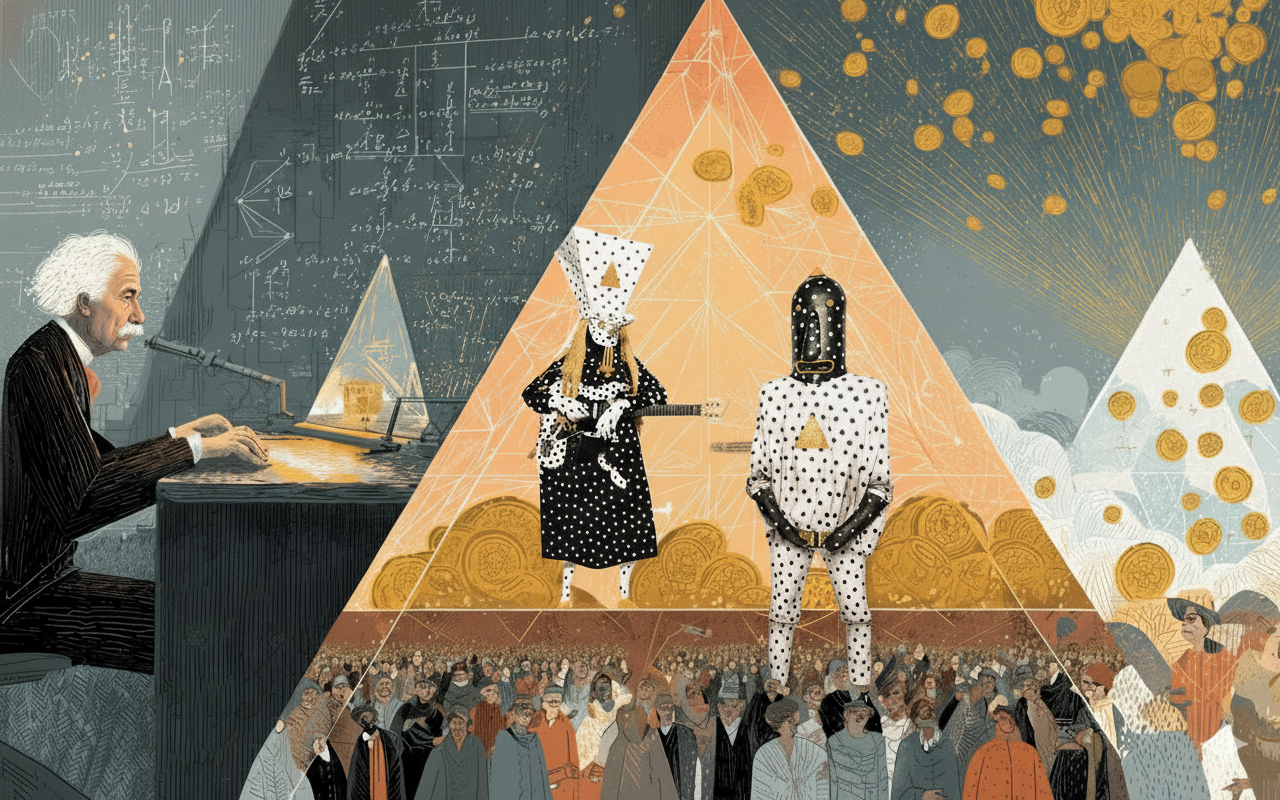
Why Angine de Poitrine's viral microtonal math rock KEXP session, Ireland's permanent basic income for artists, and Albert Einstein are three sides of the same human triangle
Two guys in papier-mâché masks from Saguenay, Quebec, have been playing music together for 20 years since they were 13 years old. For most of that time, they existed in relative obscurity. Then, KEXP posted a video of them playing four songs and the internet lost its mind. As of this week, that video has over ten million views and their song Fabienk is No. 1 on Spotify’s Viral 50 – Global chart. Dave Grohl of Nirvana and Foo Fighters fame has said they “absolutely blew his f*cking mind”. The band is Angine de Poitrine, and if you haven’t watched the full set yet, stop reading this, go watch it, and then come back. I’ll wait. Or just listen to it while you read this essay.
Okay. Now let me tell you why I think this band is one of the best arguments for universal basic income I’ve come across in a long time, and why Ireland and Albert Einstein are part of the same story.
I first want to make three points, like a triangle, because triangles are very on-brand for this article. Stick with me.
The first point is about Einstein. Albert Einstein did not become Albert Einstein in a university lab. He became Albert Einstein while working as a patent clerk in Bern, Switzerland. The job paid the bills and left him enough hours in the day to think. That was key. That was the magic formula. Genius, plus a floor under him, plus time. With those three ingredients, one man starting in his twenties rewrote physics. Special relativity. The photoelectric effect. Brownian motion. The equivalence of mass and energy. All four in a single year, 1905, while he was a patent clerk. General relativity then came a decade later. We are still living inside the consequences of what that one man thought about with his basic needs met more than a hundred years ago. GPS satellites have to correct for his equations or your phone would send you to the wrong address. The energy released by splitting an atom is accounted for by his equations. Our entire picture of space and time is his.
Now try to put a dollar figure on that. Go ahead. I'll wait again. You can't. The value one Einstein delivered to humanity is incalculably large. It dwarfs any UBI program you could ever design. And here is the Einstein Argument for UBI in one sentence: if universal basic income enables even one more Einstein to become Einstein over the course of the next century, it will have paid for itself a thousand times over.
The thing is, Einstein changed how we think about space and time because he had space and time: he had intelligence, education, a floor under him, and time to think. That's not a miracle. That's a policy choice we refuse to make. How many Einsteins never became Einsteins, because they had genius, but lacked space and time?
The second point is about artists. In 2022, Ireland did something extraordinary. The government randomly selected 2,000 artists out of more than 8,200 eligible applicants and gave them €325 a week, unconditionally, for three years. No strings. No testing beyond being an artist. Just money, every week, so they could make art. Another 1,000 artists served as a control group.
The final results came in last year, and the Irish government read them and made the program permanent. The independent evaluation by Alma Economics found that the pilot cost €72 million and generated €80 million in benefits. Artists in the program earned on average €500 more per month in arts-related income, earned about €280 less from non-arts jobs, and drew roughly €100 less per month from social services. The money let them do more of the stuff they were good at and less of the stuff that was just paying the bills. The evaluators estimated that if scaled up permanently, the program could produce a 22% increase in artistic output. Ireland’s Minister for Culture, Patrick O’Donovan, called the scheme “the envy of the world.” He’s not wrong because other countries are already discussing doing the same.
I want to say that part again because it’s important: Ireland ran the experiment and calculated an impressive return on investment. Every euro invested came back as €1.39 in benefits to Irish society.
And Ireland isn’t alone. In New York State, Creatives Rebuild New York gave 2,400 artists $1,000 a month for 18 months. The impact study found exactly what you should expect: less debt, better mental health, more time spent on art, no drop in other income, and a bunch of artists who started landing grants, residencies, and paid work in their fields because they finally had the space to pursue them. Stephen Roll, one of the lead researchers, put it well when he asked:
“What art could we produce as a society if our artists could invest more time and money in their craft? Perhaps more importantly, consider how many great artists never get to emerge because an artistic career often carries such high risks of financial hardship and insecurity.”
The pattern from Ireland and New York matches the pattern from every saturation basic income pilot we’ve ever run, going all the way back to Dauphin, Manitoba in the 1970s. When you give everyone in a community a floor of income, entrepreneurship skyrockets. New businesses get started. People take risks they wouldn’t have otherwise taken. This isn’t surprising. Starting a business is terrifying when the downside is losing your house. It’s a lot less terrifying when the downside is falling back on a basic income.
Ireland did not do this because it was a nice thing to do for artists. Ireland did it because art is an enormous economic and cultural engine, and the current system is incredibly wasteful of the people who run that engine. The Irish government calculated a monetary value for art and discovered what should have been obvious: investing in art pays more than it costs. We can apply that same math to everything a basic income unlocks.
The third point is Angine de Poitrine.
Here is what they are. They’re a two-person microtonal math rock band from Quebec. The guitarist calls himself Khn. The drummer calls himself Klek. They wear black and white polka-dotted costumes and papier-mâché masks with long noses and describe themselves as space-time voyagers. They do not speak to audiences in any real language, just in a made-up one. Between songs they form triangles with their hands and the crowd forms triangles back. They are weird in the absolute best way. They are marvelously, unapologetically, beautifully different.
Quick aside on what “math rock” actually means; math rock is rock music that uses unusual time signatures, odd rhythms, and the kind of structural complexity that makes your foot tap on the wrong beat. Where a normal pop song is in 4/4 — four beats per bar, over and over, like a heart — math rock might be in 7/8 or 11/8 or switch between them every few bars.
And on top of the math, they play microtonal music.
A quick primer for anyone who doesn't know what that means either: Western music uses twelve notes per octave. You can find all of them on a piano — seven white keys and five black. The distance between any two adjacent keys is a half step. Microtonal music uses the notes between those notes. A quarter tone sits exactly halfway between two adjacent piano keys — a pitch that, on a standard instrument, doesn't exist. Most rock and pop you've ever heard lives on whole steps and half steps. AdP lives on the steps in between. As one YouTube commenter wrote, "The elites don't want you to know this, but you can just make your own notes."
To play this music, Khn plays a custom double-necked hybrid instrument — half guitar, half bass — with twice the frets to play the microtonal notes. Klek originally built the first version himself with an actual saw. The current one was made by a professional friend. Khn plays it while looping parts in real time, with both hands, while also working a full pedalboard with his feet. I want to pause on that for a second. I can’t pick a sock up off the floor with my feet. My toes are purely decorative. This guy is using his feet as a third instrument while his hands are playing four times the notes as a normal guitarist, all while peering through his mask’s eye-holes covered by gold dollar signs.
I can’t explain why I love this band as much as I do. There’s just something happening in my brain when I listen to them that I don’t have words for. It’s like the music itself is playing me as an instrument. It’s like I never heard music before this. You know those videos of a hearing-impaired kid getting a cochlear implant and hearing their parent’s voice for the first time? That’s what it feels like when I hear AdP. It makes me very, very happy. And I want more of it. I want more art like this. Maybe that’s selfish. I don’t care. I want more artists to be able to push boundaries, to explore new ideas, to get really good at whatever brings them joy.
Because here’s the thing. Khn and Klek have been playing together for 20 years since they were 13. That’s two decades of two teenagers becoming two masters. Two decades of getting incredibly good at something that, until just months ago, almost certainly was not a significant source of income prior to going viral, and likely functioned as a passion-driven project rather than a primary livelihood. Two decades of pursuing what Khn himself has described as a series of inside jokes about rock music in general that turned, somewhere along the way, into one of the most creatively original things happening in music right now.
How many people, looking at a teenager in small-town Quebec in 2008 sawing extra frets into a guitar would have said “that kid is a genius”? I’m going to guess: none of them.
Angine de Poitrine is what happens when two people get to spend decades getting really good at something weird. They did it without UBI. Maybe they had parents who helped. Maybe they had day jobs. Maybe they had government supports I don’t know about. However they got there, they got there. But here is the point I keep coming back to: without UBI, people like this are exceedingly rare. Einsteins are rare. Khns and Kleks are rare. With UBI, they will be less rare. That is not a hope. That is a statistical near-certainty.
Which brings me to a finding I think about a lot.
A big thanks to my monthly patrons who contribute to making my articles possible and free for all. If you find value in my writing and would like to support it, please join my Patreon or become a paid subscriber on my Substack.
Talent is Everywhere. Opportunity is Not.
A few years ago, an Italian research team ran a simulation of how talent and luck interact over a 40-year working life. Scientific American covered it beautifully. What they found was that pure talent was not the best predictor of success; luck was. The most successful people in the simulation were not the most talented — they were moderately talented people who got lucky at the right moments. Which sounds demoralizing, until the researchers did the interesting part. They asked: okay, given that luck is doing so much of the work, what’s the best way to fund people so that talent actually has a chance to break through?
They tried a bunch of strategies. Giving extra funding to people who were already successful did almost nothing. It concentrated more resources in people who didn’t necessarily have the most talent, just the most luck. Mixing “reward the successful” with equal distribution did a little better. Pure random distribution did better than that. And the winner, by a wide margin, was the strategy of giving everyone an equal amount. In their simulation, distributing a small equal sum to every person every five years led to 60% of the most talented people achieving above-average success. Bumping the equal sum up a little led to 100% of the most talented people having an impact.
Let me say that again. When the researchers gave everyone the same amount of money, 100% of the most talented people in the simulation had an impact. When they gave the money only to the “deserving,” most talent went nowhere.
This is UBI. This is exactly UBI. The paper is essentially a mathematical proof that a world with universal basic income is more meritocratic than a world without one, because luck-based distribution — which is what we have now — throws away most of the talent in the room. A UBI world isn’t a world that rewards laziness. It’s a world where the Einsteins and the Khns and the Kleks and the creatives you’ve never heard of yet actually get a shot at mastery that their talent deserves, instead of getting filtered out at age 19 because they couldn’t afford rent.
There’s a history lesson hiding in here that I want to pull out before I go any further. A huge amount of the best music ever made in the UK — The Clash, The Specials, UB40 (literally named after Unemployment Benefit, Form 40), Pulp, Oasis, and many more — was made by people who were, at the time, living on “the dole.” When Britain had a welfare system that gave artists a tiny floor of income and left them mostly alone to do their thing, Britain produced some of the most important popular music of the twentieth century. When that system was dismantled and means-tested and hoop-jumped and shamed out of existence, that pipeline dried up.
The dole worked as a floor. Not a universal one. Not an unconditional one. It came with strings. It was means-tested or contribution-based, which meant earning money reduced it, sometimes sharply. It came with conditions. Forms. Appointments. Proof that you were looking for work. And if you failed those conditions, there were sanctions. Payments cut or stopped. It also came with stigma. You had to declare yourself “unemployed” and submit to a system designed to monitor and correct you. Despite all that, it still did something important. It gave people just enough stability, in some cases, to create.
UBI keeps the only part that mattered—the floor—and removes the rest. No means tests. No earnings penalty. No proving you deserve it. It just shows up, whether you’re earning or not, and leaves you alone to decide what to do with your time.
This is What “Truly Human” Feels Like
Here is the question I want you to sit with. What is it about Angine de Poitrine that has made grown adults in the comments section write things like “30 seconds in: ‘this is fucking stupid’ 18 minutes in: ‘this is the greatest musical performance of the century” and “It’s the first time I’ve felt like a teenager listening to music since I was one”? Why this band? Why now?
I think part of it is that this is happening at the exact moment AI-generated art is flooding the internet. Every day there is more “AI slop.” We are surrounded by the remixing of what already existed into something smoother, less surprising, more average. And into that ocean of generated averageness, two genius maniacs from Quebec walk in wearing polka-dot costumes and start playing notes that don’t exist on a piano, using a custom double guitar with twice the frets each, moving their feet like hands, and the comments section lights up with one phrase repeated over and over: this is truly human.
Because it is. Whatever “truly human” means, this is it. Exploration. Creativity. Joy. Fun. The willingness to try something that might fail and look ridiculous. The willingness to saw extra frets into a perfectly good guitar because you had an idea and you had to play around. The willingness to spend twenty years on something that may never “pay off” in the financial or fame sense. AI can remix the old into new arrangements. And yes, humans remix everything too — every artist is influenced by other artists, every idea builds on older ideas. But there is something qualitatively different about what Einstein did, and what AdP is doing, and what every once-in-a-generation artist or scientist does when they show us something we’ve never seen before. It is the opposite of averaging. It is a leap into new territory. It is what humans do when they are free enough to follow the weird thing.
No matter how good AI gets, I promise you there will always remain a deep, stubborn love for what humans like Khn and Klek make, because part of what we love about AdP is knowing that a real person spent years of their actual life getting good enough to play that. The joy on the other end of the screen is real because the joy on the stage is real.
Genius from Scenius
Brian Eno — the producer, composer, and philosopher of ambient music, the guy who shaped records by Bowie, Talking Heads, U2, and roughly half of the sounds you associate with the last fifty years — has a word for what I’m circling around, and it’s better than any word I’ve come up with. The word is scenius. It’s his coinage. It means the collective form of genius that emerges from a scene. The idea is that individual geniuses don’t pop out of a vacuum. Einstein didn’t happen in a box. Einstein happened inside a culture of physicists arguing with each other in the early twentieth century, reading each other’s papers, correcting each other’s math, building on each other’s ideas. The “genius” is the visible tip of an enormous submerged iceberg of other people doing related work. Scenius is the iceberg.
And Eno, for exactly this reason, supports UBI.
Eno’s argument is that the “need to earn a living” is actively hindering us from reaching our collective potential. If we want more geniuses, we need more scenius, and if we want more scenius, we need more people who are free to participate in the scene without having to focus every hour of their life around survival. He has said, in so many words, that UBI is the closest thing he has ever seen proposed to the future he actually wants — a future where the sheer cooperative potential of billions of differently-shaped human minds finally gets to express itself.
I think he’s right, and I think AdP is proof. Because Khn and Klek aren’t alone. They grew up inside a scene. They were absorbing Indian, Japanese, Arabic, Indonesian, and Turkish music as teenagers. They were listening to King Crimson and Zappa and Gentle Giant. Saguenay had a music scene. Quebec had a festival circuit. Someone at Trans Musicales in Rennes booked them. Someone at KEXP in Seattle chose to record them. Someone at the Montreal Jazz Festival let them play. And now, there are guitarists on YouTube and bass players on Instagram and composers in tiny apartments in cities you’ve never heard of watching the KEXP session for the 100th time and reaching for plastic zip ties to play quarter tones. AdP has already joined the scenius. They are now part of the raw material other people are going to make their own weird new things out of.
The dole era in Britain was scenius too. The Clash did not happen alone. The Specials did not happen alone. UB40 did not happen alone. Those bands were in pubs and rehearsal rooms and record shops, rubbing up against each other, ripping each other off, fighting, collaborating, improving, and the dole was what paid the rent on all of that. Take away the floor and the whole scene collapses. Britain learned that the hard way. It is, as Eno puts it, what happens when you make everyone spend all their time earning a living instead of contributing to the shared well.
We are all born different. Every human is a unique instrument with its own weird little tuning. UBI is the thing that lets us actually find out what we sound like together — lets the microtones between us ring out instead of getting tuned away. Scenius is the sound of a whole society finally in tune with its own diversity. We have never heard that sound. I would very much like to.
People ask all the time: what will people do with UBI? Won’t they just get lazy? Will they lose their sense of purpose and meaning? Will they stare at the wall?
No. Of course not. They will figure out cool new stuff. They will impress the hell out of the rest of us with how creative they can be when they aren’t forced to spend eight hours a day filling out forms for no real purpose, in what the late anthropologist David Graeber (who also supported UBI by the way) rightly called bullshit jobs. Humans are the most creative species we know of in the universe, and most of that creativity is being wasted right now on make-work and survival. Free it up, and watch what happens. Some people will make bad art. Some people will make good art. Some people will make a microtonal double-guitar and paint themselves with polka dots. Most people will just live better, which is also fine.
The Point of Bread is to Eat It
In his 1932 essay “In Praise of Idleness,” Bertrand Russell pointed out that the whole economy is built on the assumption that production is noble and consumption is frivolous. You make the bread, you are virtuous. You eat the bread, you are wasting time. Russell thought this was absurd, and he was right. The point of bread is not to fuel you to make more bread. The point of bread is to be eaten and enjoyed. To take a few minutes of your day to sit down and think, “damn, that’s some good bread.” Maybe alone. Maybe with someone you love. Maybe with enough time to invent a new sandwich and hand it to a stranger who then wonders if bread was always this ambitious.
Work is important. Nobody is saying work is not important. But the fruits of work are the whole point of work. If you spend your whole life too busy cooking to ever eat, something has gone very wrong.
As I wrote in the Monsters, Inc. Argument for UBI, we are currently running an economy on fear, when joy turns out to be ten times more powerful. A world where more people get to do the science and the art they actually want to do — instead of whatever happens to pay the bills — is a radically better world than the one we live in now. Angine de Poitrine and Einstein are what we get when people are free to do what they truly want. The current world is what we get when most of them can’t.
One more thing before I wrap, because I have not seen anyone else point this out and I can’t stop thinking about it. Look closely at the polka dots on their costumes and their stage backdrops. The dots aren’t arranged horizontally and vertically. They’re rotated 45 degrees. Take that pattern and rotate it back 45 degrees — the dots sit in perfect squares. Rotate another 90 degrees — still squares. The world most of us see. But rotate it that extra quarter turn, the quarter turn they live at, and suddenly the same dots aren’t sitting in squares anymore. They’re sitting in bisected squares — aka triangles. And diamonds. And, if you let your eyes relax a little, cubes. A whole different geometry pops out of the exact same dots.
I think Khn and Klek did a quarter turn to the world. Where the rest of us saw nothing but squares, they saw triangles and diamonds and a hidden dimension that was there the whole time. And now, because we get to watch them, we get to see what they see. We get to borrow their quarter turn. It is, quite literally, glorious.
So let me tie this triangle together.
What Humans Become When They’re Free
Einstein became Einstein, partly because he had a patent clerk’s salary and the time to think. With UBI, more Einsteins will have a version of that combination, and even one more Einstein — just one — pays for every dollar UBI ever cost, and gifts humanity centuries of progress. Science is essential. But it is only half of the picture.
The other half is art. Who are the artist Einsteins? Or maybe I have the question backwards, and the real question is: which artist was Einstein most like? Einstein himself said imagination was more important than knowledge, and he played the violin his whole life, and he thought in pictures. He loved math and he loved music. He said that if he had not been a physicist, he probably would have been a musician.
Math and music have always been the same language spoken two different ways. So maybe the better question isn’t which artist Einstein was like. Maybe the better question is: which mathematician is Angine de Poitrine most like? We need both art and science, and we need more people free to get really good at whichever one brings them joy — especially those who, like Einstein and like AdP, refuse to believe the two are really different things.
Ireland ran the experiment on artists and got a positive return on investment within three years. New York ran the experiment and got a bunch of artists the time and space to finally breathe and create. Every saturation basic income pilot in history has shown that giving everyone a floor leads to more entrepreneurship, more creativity, more risk-taking, more health, more community. The results are in. The studies are done. The math has been checked.
And into this moment of proof walks AdP, fresh off a KEXP session with over 10 million views, looking like a Dada painting, playing the notes between notes, showing us something new under the sun. Two guys from Quebec who spent twenty years perfecting their craft before it ever popped off. This is what human beings do when they have the time and space to do it. Einstein and Angine de Poitrine are not exceptions to the rule. They are the rule of what humans can be when they are free. The exceptions are how few of them we currently get.
With UBI, we will get more. More Einsteins. More Khns and more Kleks. More bread worth eating. More sandwiches we haven’t invented yet. More art that makes you feel like you’re hearing music for the first time, like a bunch of neurons in your brain just woke up and asked where this has been your whole life.
If you already support UBI, keep supporting it. If you don’t yet, I hope this article moved you a quarter-note closer. And whatever you do, please go watch the full AdP session on KEXP. Make a triangle with your hands and waves with your arms while you watch. You’ll know when.
That’s the Angine de Poitrine argument for UBI. I hope it helped connect some dots.
If reading this was worth your time, it’s worth sharing. Share it, subscribe for free, and if you can, make a monthly pledge to keep this work going.

Thank you to my UBI Producer level patrons: Gisele Huff, Steven Grimm, Bob Weishaar, Judith Bliss, Lowell Aronoff, Jessica Chew, Katie Moussouris, Tricia Garrett, A.W.R., Daryl Smith, Larry Cohen, John Steinberger, Philip Rosedale, Liya Brook, Frederick Weber, Dylan Hirsch-Shell, Tom Cooper, Joanna Zarach, Mgmguy, Albert Wenger, Jeremy Wertheimer, Andrew Yang, Kimi Avary, Peter T Knight, Michael Finney, David Ihnen, Janos Abel, Miki Phagan, Draper Kauffman, Walter Schaerer, Elizabeth Corker, Albert Daniel Brockman, Joe Ballou, Arjun Banker, Christine Celli, Felix Ling, Jocelyn Hockings, Mark Donovan, Jason Clark, Chuck Cordes, Mark Broadgate, Leslie Kausch, centuryfalcon64, Deanna McHugh, John Sullivan, Stephen Castro-Starkey, CodyS, chris heinz, Zachary Weaver, bradzone, Tim, Warren J Polk, Jeffrey Emmett, Nicolas Pouillard, Eric Skiff, Thomas Welsh, Linda Hearne, David Allen, Liz, and all my other monthly patrons for their support.
Looking for a UBI-focused nonprofit to support? Donate to the Income To Support All (ITSA) Foundation to support UBI projects focused on research, storytelling, and direct implementation to realize economic freedom for all.
Universal Basic Income: It’s a foundation!
 Scott Santens

UBI Guide Newsletter
Join the newsletter to receive the latest updates in your inbox.