The Universality Argument for Basic Income

Why including everyone — yes, even billionaires like Elon Musk — works better than means-testing ever possibly can
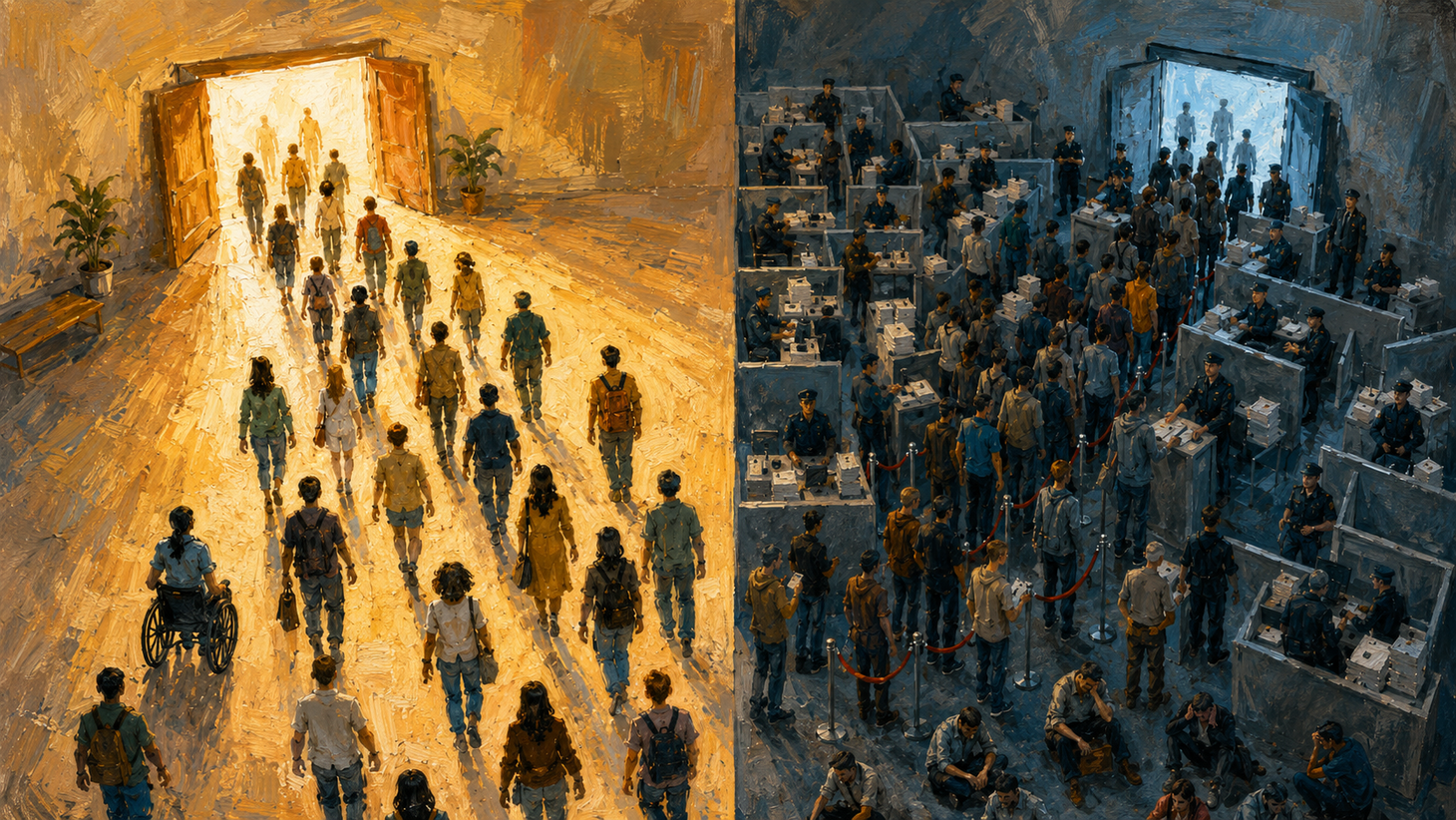
Imagine a room with a thousand people. You know that 999 of them need something to survive, and one of them doesn’t. You have two options. Option one: give the same thing to all 1,000 people, and when they leave through a door where everyone’s income is already being checked, take a bit more from the one person who didn’t need it. Option two: before giving anything to anyone, set up an additional checkpoint inside the room, hire people to run it, create paperwork, establish eligibility rules, and test all 1,000 people — knowing that the test will incorrectly fail dozens if not hundreds of people who actually need help — all to avoid giving something to one person for whom the amount is a rounding error.
That is the choice between universal basic income and means-tested anything. When you frame it honestly, the answer is obvious. But we don’t frame it honestly. We frame it as responsible budgeting versus reckless spending. We frame it as helping the deserving versus subsidizing the rich. We frame it in ways that serve the interests of the people who benefit most from the means-tested version. And those people, as I’ll explain, are not the poor.
I have been making this argument for over a decade. I am going to make it one more time, and I am going to make it so thoroughly that I never have to make it again. If you believe basic income should exclude those with high incomes, I am asking you to read this entire article before you decide I’m wrong.
The Inconvenient Math of Targeting
The single most important thing to understand about means-testing is that it does not work the way people think it works. People imagine a clean binary: the needy get helped, the non-needy don’t. In reality, the moment you add a test to a benefit, you create two kinds of errors. A false positive is when someone who doesn’t need help gets it anyway. A false negative is when someone who does need help gets excluded.
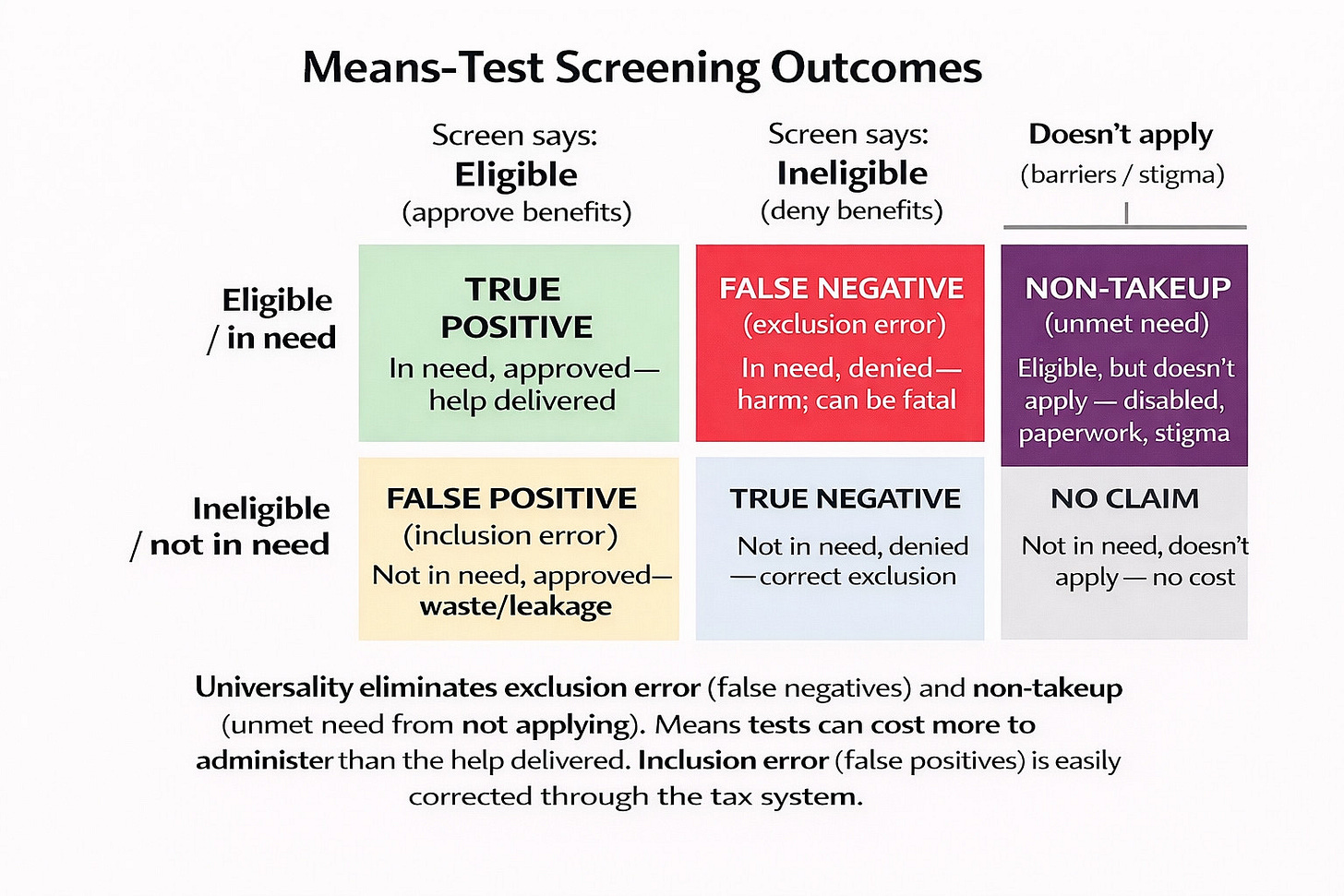
Here’s what most people don’t think about: these two errors are not equally dangerous. A false positive — Elon Musk getting $15,000 he doesn’t need — is a waste of $15,000, which is approximately what he earns in the time it takes him to salute. A false negative where a single mother get excluded from the help she desperately needs can mean eviction, hunger, medical crisis, or death. One error is wasteful. The other is fatal. Any serious system designer knows which one to prioritize avoiding.
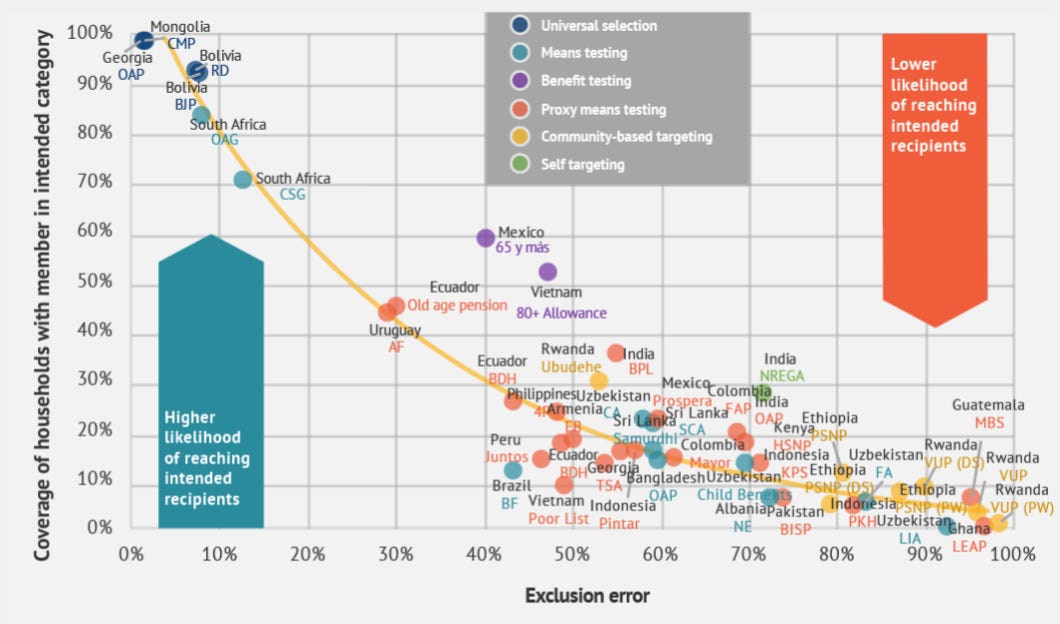
The evidence on how badly targeting fails is damning. Development Pathways conducted an exhaustive global review of 38 poverty-targeted social protection programs across 23 countries and found that these programs miss between 44% and 97% of the people they are designed to reach. The best-performing targeted programs still exclude nearly half of the people they exist to help. The worst exclude almost everyone.
In contrast, universal programs have the lowest exclusion errors. Bolivia’s universal social pension excluded only 8% of its intended recipients. Mongolia’s universal child benefit excluded just 2%.
This is not a minor difference. This is the difference between a system that works and a system that mostly doesn’t.
The Staggering Cost of Testing People
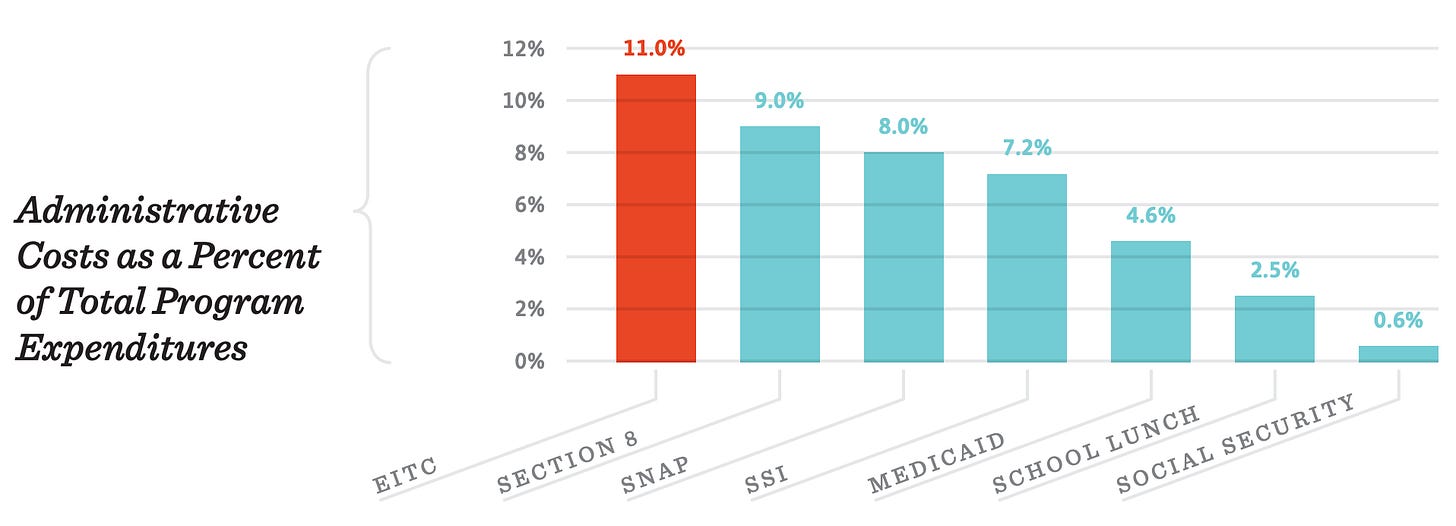
One of the great ironies of means-testing is that it’s supposed to save money. But the logic ignores the cost of the testing itself — the bureaucrats, the paperwork, the IT systems, the appeals processes, the consultants, and the inevitable errors that require corrections.
Georgia’s Pathways to Coverage program is perhaps the most egregious recent example. The state’s Medicaid work requirement experiment, according to a GAO report, spent $54.2 million on administrative costs compared to just $26.1 million on actual health care. The program designed to test whether people deserve health coverage spent more than twice as much on the testing as on the coverage. Senator Raphael Warnock called it what it was: the real waste, fraud, and abuse. The administrative apparatus designed to prevent waste was the waste.
This is not unique to Georgia. The Earned Income Tax Credit — the closest thing America has to a negative income tax — costs recipients an average of 11% of their benefit in tax preparation fees, and one in five people who qualify for it don’t receive it at all because they don’t file or file incorrectly. One in four EITC payments is miscalculated.
Compare this to Social Security, which is universal among retirees. Its administrative overhead is 0.5%. A universal basic income distributed through existing SSA infrastructure would likely be even lower. It’s extremely cheap to direct-deposit identical payments to everyone. It’s extremely expensive to figure out who deserves them first.
Every dollar spent on administration is a dollar that could have gone directly to a person who needed it. The question is not whether we can afford to include the rich. The question is whether we can afford to keep paying middle-men to exclude them.
The “Too Expensive” Illusion
The most common objection to universality is that it costs too much. If you give a basic income to 260 million adults instead of 230 million, that’s 30 million extra payments. At $15,000 each, that’s $450 billion more. How could that possibly be affordable?
It’s the wrong math. The error is treating the gross cost as the net cost. When someone with a high income receives $15,000 in basic income and pays $20,000 in additional taxes to fund it, the net cost of including that person is not $15,000. It’s negative. That person is a net contributor, not a net recipient. The $15,000 goes out and more than $15,000 comes back. The cost of including them is zero. In fact, they’re subsidizing everyone else.
This is true for everyone above the breakeven point — the income level at which the additional taxes paid equal the basic income received. Below that line, you’re a net recipient. Above it, you’re a net payer. A universal basic income and a negative income tax that phases out at the same rate and reaches the same people produce the exact same distribution of net gains and losses. The only difference is that the universal version sends a check and collects a larger tax, while the means-tested version sends a smaller check and collects a smaller tax. The net transfer is identical. One is not cheaper than the other.
What the phaseout actually does is concentrate the tax burden on the people being phased out — typically the middle class or upper-middle class — while shielding the very top from higher taxes. A phaseout that starts at the 90th percentile and ends at the 95th percentile is a tax on those five percentiles that lets the top 5% off the hook. A universal program funded by broad progressive taxation spreads that burden all the way to the top.
I’ve covered this math in detail elsewhere. But the bottom line is this: a means-tested guaranteed income is not cheaper than a universal one. It just hides the taxes inside the phaseout instead of collecting them openly. And in doing so, it taxes the middle while protecting the top.
Who Really Benefits from Targeting?
There’s a question most people never think to ask: if targeting helps the poor, why do the rich keep supporting it?
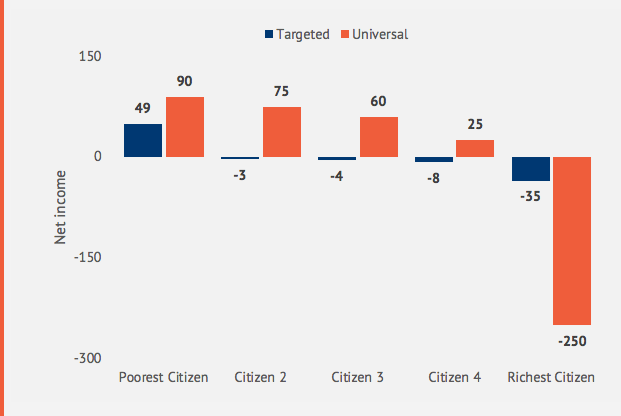
Development Pathways published a devastating analysis of exactly this question. The conclusion is counterintuitive but critical: the main beneficiaries of poverty-targeting are the rich, while the poor are the main beneficiaries of universal provision. Targeted programs minimize the tax burden on the wealthy because the programs are small. Universal programs require the wealthy to pay substantially more, and in exchange, everyone — including the poorest — gets more.
This is why poverty-targeted programs dominate in countries where the wealthy hold outsized political influence. A key aim of poverty-targeting is to minimize taxation, which disproportionately hits the wealthy even when taxation is flat. The World Bank itself has acknowledged that the push for “better targeting” is more often motivated by cutting entitlement bills than by helping the poor.
The middle class is continually fooled into supporting all of this. They are told that targeting is more efficient, more progressive, more responsible. But what targeting actually does is impose less of a burden on the rich and provide less of a benefit to the poor and middle class than a universal approach would. How convenient for the people at the top for means-testing to be considered “common sense.”
Universality Makes Programs Indestructible
A program for all is harder to kill than a program for some. A program that everyone receives becomes a right. A program that only some people receive becomes a target.
Since 1982, every Alaskan has received an annual dividend from the Alaska Permanent Fund regardless of income. No Alaskan views it as welfare. It’s a shared right to natural resources. It would be wrong if only oil companies and their shareholders benefited from Alaska’s oil. The dividend ensures that wealth is rightfully shared. And because everyone gets it, everyone defends it. Now imagine if that dividend had been means-tested. Would it still exist four decades later? Or would the oil companies and their shareholders have found a way to kill it and keep the money for themselves? I think you know the answer.
The same principle holds for education and health care. Should rich kids be excluded from public school? If they were, rich parents would slash their property tax bills, because they’d be paying for a system their children couldn’t use. Public school quality would collapse. Should high-income seniors be excluded from Medicare? The political coalition defending it would shrink and the program would weaken. Universality among seniors is what makes Medicare a third rail of American politics. That’s exactly the kind of political durability that wealthy interests want to avoid.
The Marginal Tax Rate Trap
Here is where means-testing does its cruelest work. Every means-tested benefit comes with a clawback where the benefit is reduced as income rises. That clawback is economically identical to a tax on earned income.
SNAP reduces benefits by 30 cents for every dollar earned. That’s a 30% marginal tax rate imposed on some of the poorest people in the country. SSI reduces benefits by 50 cents for every dollar earned past a small exclusion. If you receive both benefits, you’re looking at an 80% marginal tax rate on earned income. Add in the loss of Medicaid, housing assistance, or childcare subsidies, and the rate can exceed 100%. Someone can earn a dollar and lose more than a dollar.
Why are we imposing the highest marginal tax rates in the country on the people with the least income, in the name of helping them? We are punishing them for trying to increase their incomes, taxing them at rates that would cause a revolt if imposed on the wealthy. We could choose to move the phaseout to the middle class, but then they’d be the ones hit by those rates.
A universal basic income carries a zero percent marginal tax rate from the payment itself, because the payment doesn’t change with income. The only rate a UBI recipient faces comes from taxes, which can be designed progressively. Instead of a 30% clawback hitting someone, a low surtax could apply across a broader range and generate the same revenue — extending all the way up the income scale to the very top, so instead of only the poorest paying for the phaseout, the wealthiest help pay for it too. Any phaseout is mathematically equivalent to a surtax, but the surtax version spreads the burden instead of concentrating it on those who can least afford it.
There's an additional reason to shift that burden upward rather than leave it at the bottom: those with higher incomes are the least likely to change their actual work behavior in response to higher marginal tax rates. Piketty, Saez, and Stantcheva analyzed top earner responses to taxation across 18 OECD countries and found that top earners barely reduce their actual work when taxed more. Meanwhile, research using Danish administrative data found that low-income workers are the most sensitive. Higher marginal tax rates depressed their wage growth and reduced their likelihood of seeking promotions or better-paying jobs. In other words, we are currently imposing the highest marginal tax rates on the people most likely to change their behavior because of it, while shielding the people least likely to change theirs. Universality corrects this by moving the burden to where it does the least harm.
Universality Eliminates Stigma
When everyone gets something, no one is ashamed to receive it. When only the poor get something, receiving it becomes an admission of failure.
This is not abstract psychology. It is a measurable crisis of program design. Research published using USDA data found that 45% of SNAP-eligible nonparticipants cited stigma as a reason for not participating. A 2025 study confirmed that over 30% of eligible individuals across major U.S. welfare programs do not access the benefits they qualify for, and identified perceptions of public stigma as a key barrier. A comprehensive review found that take-up rates across means-tested programs in various countries range from as low as 25% to 80%, and concluded that stigma is likely the main determinant of low take-up.
Think about what this means. If you design a program specifically to help people in need, and a third of them refuse to accept the help — not because they don’t qualify, but because of what they think accepting it says about them — then the program itself is a failure. It is the insistence on targeting only those in need that creates this situation. A universal program would not create it, because there is nothing to be ashamed of when everyone receives the same thing. Stigma is a direct product of targeting. Universality eliminates it entirely.
The most vivid proof of this may be school lunches. Under the traditional means-tested model, some kids get free lunch and everyone knows who they are. The Campaign for Children reports that children from low-income households face bullying, have already-served lunches discarded in front of them, are marked with stickers, or are forced to complete chores — all because of a system designed to help them. Schools that adopted universal free meals saw participation rise by an average of 6.8% for lunch and 12.1% for breakfast, and saw a 15% decline in suspensions by the third year, particularly among students who had previously received subsidized meals. Research in New York City found that universal meals led to reductions in bullying. Yes, that means the kids of wealthy families eat for free too. Is that a bad outcome? Of course not. It is the outcome that makes the program work for the kids who actually need it, by removing the very thing — visible differentiation — that was keeping them from participating or subjecting them to harm when they did.
You Can’t Use What You Don’t Know Exists
Stigma is one barrier to take-up. Ignorance is another. Means-tested programs are complicated by design, and millions of people who qualify for them simply don’t know it. They don’t know they’re eligible. They don’t know the program exists. They don’t understand the application process. They file the wrong form, or miss a deadline, or can’t find the right office, or give up after being put on hold for the third time.
New Mexico just proved this decisively. In November 2025, the state became the first in the nation to offer universal free child care with no income limits. Before that, families earning under 400% of the federal poverty level — roughly $128,000 for a family of four — already qualified for free child care. Four in five New Mexico families were already eligible. Yet when the state made child care universal, something remarkable happened. According to the state's own data, 54% of newly enrolled families had already been eligible under the old means-tested rules but had never enrolled. More than half of the families who signed up after universality didn't need universality to qualify. They needed universality to participate. Whether it was stigma, lack of awareness, confusion about eligibility, or something else — the targeted version failed to reach them. The universal version succeeded.
A universal basic income eliminates these kinds of problems entirely. You don’t need to know you qualify, because everyone qualifies. You don’t need to navigate a bureaucracy, because there is no bureaucracy to navigate. You don’t need to file a special application, because no application exists. The money simply arrives, the same way for everyone, whether you have a tax attorney or whether you’ve never filed a return in your life. That is what it means to design a system that actually reaches the people it’s supposed to reach.
The Engineering Principle
I originally studied engineering, and there’s an old engineering joke I love: before studying engineering, if someone asked me what 1 + 1 is, I’d have said 2. After studying engineering, I’d say I’m pretty sure it’s 2, but we’d better make it 3 just to be safe.
That joke contains a profound truth about systems design. Engineers know that things fail. When you’re building life-support systems, you wisely design for failure. You build in fault tolerance, redundancy, and graceful failure.
A means-tested safety net is a bang-bang system. You qualify or you don’t. If you fall through the cracks, you hit zero. A universal basic income is proportional control. It’s always there. If your income drops, you still have it. If you lose your job, you still have it. If a disaster shuts down your work overnight — you still have it. You never hit zero.
The pandemic proved this in real time. When COVID-19 hit in 2020, the government sent stimulus checks based on the most recent tax return on file, which for millions of people, was their 2018 return. Someone who earned $100,000 in 2018 but was earning less than that in March 2020 was excluded based on income they no longer had. The test used data that was two years old to determine who needed help at that moment.
Had a universal basic income been in place, none of this would have mattered. The floor would have been there the day the pandemic hit. No applications. No processing delays. No old data. No exclusions. That is what engineers mean by fault tolerance.
The Trust Problem
There’s another cost to exclusion that doesn’t show up on any budget spreadsheet: the erosion of social trust.
Research published in the American Journal of Political Science examined Pakistan’s national unconditional cash transfer program and found that being excluded from a benefit program — especially when you feel economically deprived — actively erodes trust in government. International comparative research by Naoki Akaeda confirmed this at a global scale: low-income targeting crowds out social trust, while universalism grows social trust.
We live in an era of collapsing institutional trust. One of the contributing factors is that millions of people interact with government systems designed to determine whether they deserve help, and those systems regularly tell them they don’t — even when they do. Universality eliminates this. Everyone is included. No one has to prove they deserve it. And UBI pilot after UBI pilot has shown that when you give people unconditional cash, trust goes up. This is the predictable consequence of treating people as humans with rights rather than applicants under suspicion.
Just Tax the Rich
Let me address the Elon Musk question directly, because it comes up every time.
Yes, under a UBI of $1,250 per month, Elon Musk would receive $15,000 a year. And yes, under any competent tax system, his taxes would increase by far more than $15,000. He would not be a net recipient. He would be a substantial net contributor. The UBI would function as a tax cut for the poor and middle class and a tax increase on the wealthy, but because everyone receives the same base amount, it could be perceived as a universal right rather than government charity.
But let’s say we couldn’t get his taxes right. Let’s say he evaded every additional dollar and got the full $15,000 for free. So what? That amount is meaningless to him. It is not worth building an entirely separate bureaucratic apparatus to test hundreds of millions of people just to exclude him and the tiny handful of people like him.
And don’t tell me we can’t tax a wealthy person at least $15,000 more. Of course we can. That amount is nothing to them. But beyond that, we can invest more resources in the IRS. We can close loopholes. We can raise rates on capital gains. We can implement a wealth tax. We can shift taxes onto bases that are harder to avoid, like consumption taxes, or impossible to avoid, like land value taxes. Saying we can’t tax the rich is lazy and defeatist. We can, we must, and a universal program is what creates the political will to do it, because the middle class has skin in the game by benefiting too.
The Politics of Inclusion
Does it really make sense to tell the people who pay the most in federal taxes that they don’t deserve to participate in the programs their taxes make possible? That’s bad policy and terrible politics. It turns potential allies into opponents. If high-income taxpayers receive a UBI, they have a reason to defend it. If they’re excluded, they have every reason to kill it. Programs for the poor become poor programs, because the people with the most political power have no personal stake in keeping them strong.
Andrew Jackson said something about this nearly 200 years ago that I think about often. He described what government should provide as:
“a plain system, void of pomp, protecting all and granting favors to none, dispensing its blessings, like the dews of Heaven, unseen and unfelt save in the freshness and beauty they contribute to produce.“
That’s universality. Blessings that fall on everyone, like rain, creating conditions for everyone to flourish.
The Least Important Opinion in the Room
I want to address something directly to anyone with high income or wealth who opposes universality because they personally don’t want a basic income.
You are centering yourself in a conversation where you should listen to those experiencing means-testing first-hand. Your aesthetic discomfort with receiving money you don’t need is not more important than the material survival of people who have spent their entire lives being failed by the targeting systems you are defending. The people who would benefit most from a UBI — people who have actually experienced means-testing, who have been denied benefits they qualified for, who have been humiliated by caseworkers, who have watched their marginal tax rates exceed anything the richest have paid since the 1970s — those people want it to be universal. They want you to get it too. They want that because they know from lived experience that the moment you add a test, people like them fall through the cracks.
If someone living in poverty is willing to let you have $15,000 you don’t need so that they can be sure they will actually receive the help they do need, then your opinion about wanting to be excluded is the least important opinion in the room. The data supports universality. The economics support universality. The political science supports universality. And the people whose lives depend on getting this right support universality. If none of those arguments move you, then at the very least, go apply for welfare and get denied. Just for fun.
What We Lose by Excluding
When you means-test a benefit, you exclude many, if not most, of the people you’re trying to help. You can spend twice as much on testing as on care. You impose high marginal tax rates on the poorest people in the country. You create stigma that discourages people from seeking help. You build a system without fault tolerance that lets people hit zero. You erode the trust that holds communities together. You create weaker programs that are easier for the wealthy to attack. And you save the rich money on taxes while telling yourself you’re being progressive.
When you make a benefit universal, you reach everyone. You let the existing tax system handle the redistribution. You eliminate the bureaucratic waste. You preserve work incentives. You remove stigma. You build trust. You create a permanent floor that catches every person no matter what happens to the economy. You build a program so popular it becomes politically untouchable.
People’s hearts may be in the right place when they insist on only helping people in need. But doing that requires defining need, and bureaucrats are terrible at that. And the impacts of that targeting create work disincentives, create stigma, create costly bureaucracy, create weaker programs, and require less taxation of the rich than a universal program would. It is simply the wrong answer to insist on excluding the rich. Include them. And tax them.
I believe that the insistence on excluding the rich from public benefits is one of the most successful pieces of propaganda ever sold to the middle class. It sounds compassionate. It sounds fiscally responsible. It sounds like common sense. But it serves the interests of the people at the very top, because it guarantees that taxes remain lower for them, programs remain weaker, and the political coalition defending economic security remains fractured instead of united.
Andrew Jackson wanted the blessings of government to fall like the dews of Heaven — unseen, unfelt, and universal. Instead we built a system of checkpoints and gatekeepers that spends more money deciding who deserves help than it spends on the help itself. The dew doesn’t ask the grass whether it earned the right to be watered. It just shows up. That’s how a basic income should work. For everyone. Including the people who don’t need it. Because including them is what makes the system actually work for everyone who desperately needs it.
If reading this was worth your time, it’s worth sharing. Share it, subscribe for free, and if you can, make a monthly pledge to keep this work going.

Thank you to my UBI Producer level patrons: Gisele Huff, Steven Grimm, Bob Weishaar, Judith Bliss, Lowell Aronoff, Jessica Chew, Katie Moussouris, Tricia Garrett, A.W.R., Daryl Smith, Larry Cohen, John Steinberger, Philip Rosedale, Liya Brook, Frederick Weber, Dylan Hirsch-Shell, Tom Cooper, Joanna Zarach, Mgmguy, Albert Wenger, Jeremy Wertheimer, Andrew Yang, Kimi Avary, Peter T Knight, Michael Finney, David Ihnen, Janos Abel, Miki Phagan, Draper Kauffman, Walter Schaerer, Elizabeth Corker, Albert Daniel Brockman, Joe Ballou, Arjun Banker, Christine Celli, Felix Ling, Jocelyn Hockings, Mark Donovan, Jason Clark, Chuck Cordes, Mark Broadgate, Leslie Kausch, centuryfalcon64, Deanna McHugh, John Sullivan, Stephen Castro-Starkey, CodyS, chris heinz, Zachary Weaver, bradzone, Tim, Warren J Polk, Jeffrey Emmett, Nicolas Pouillard, Eric Skiff, Thomas Welsh, Linda Hearne, David Allen, Liz, and all my other monthly patrons for their support.
Have you signed and shared the AI Pledge for Humanity in support of UBI?
 Scott Santens

UBI Guide Newsletter
Join the newsletter to receive the latest updates in your inbox.