The Primordial Credit Argument for Unconditional Basic Income (UBI)

What David Graeber’s Debt: The First 5,000 Years reveals about gratitude, interdependence, and why UBI is the smallest acknowledgment civilization can make to the unpayable debt of being alive
Every time I drop a bag of garbage down the chute in my building, I think about debt.
Not the kind you pay back in monthly installments. Not the kind that shows up on a credit report. I mean the kind you can never repay no matter how long you live or how hard you work. The debt of being alive at all.
Someone built that chute. Someone engineered the pipes that carry water to my faucet and the sewers that carry it away. Someone built the truck that takes the garbage somewhere I will never see, and someone built the road the truck drives on, and someone refined the diesel, and someone before them figured out that crude oil was useful for anything at all. The chain goes back to people whose names I will never know. Every time I drop that bag, I am the beneficiary of thousands of years of accumulated effort. I did almost none of that work. I will never be able to do enough work to repay it.
This is the idea David Graeber surfaces in Debt: The First 5,000 Years, drawing on the French anthropologist Philippe Rospabe. Long before money was a medium of exchange or a unit of account, it was something stranger. It was an acknowledgment that you owed something you could never give back.
Rospabe studied “primitive money” — the cattle, shells, brass rods, and copper bracelets used in marriage payments across societies on every inhabited continent. The conventional reading was that these were bridewealth: a man’s family paid the bride’s family to compensate them for the loss of her labor. Rospabe argued the opposite. The payment was not compensation. Nothing of that scale could ever be compensation. A woman who joined a new family and bore children for that family handed over something even a large quantity of goods could never match. The payment was instead, in Graeber’s phrasing, “not to settle a debt, but as a kind of acknowledgment that there exists a debt that cannot be settled.”
Money, Graeber wrote, summarizing Rospabe, “begins, as Rospabe himself puts it, ‘as a substitute for life.’” One might call it a life-debt. “Money is first and foremost an acknowledgment that one owes something much more valuable than money.”
Read that sentence again. Money is first and foremost an acknowledgment that one owes something much more valuable than money.
This is what unconditional basic income actually is. Not a welfare program. Not a stimulus. Not a transfer. UBI is a society asking for something so uniquely valuable that payment of any sort would be impossible — and offering, in return, the smallest possible gesture of recognition. UBI is lifewealth. Not paid to settle a debt, but paid to acknowledge a debt that cannot be settled.
The Time Cone
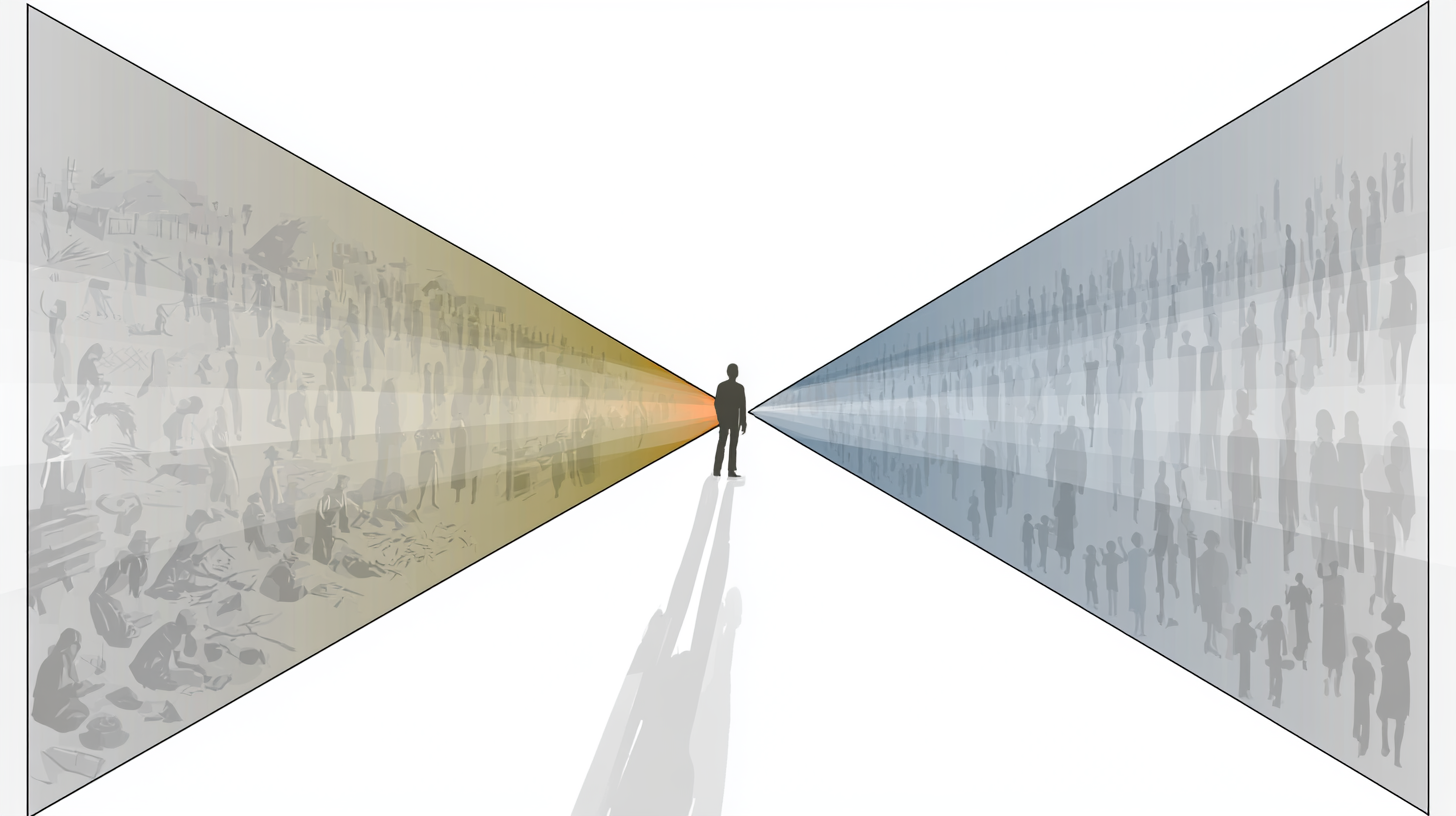
Imagine your life as a point. Behind you stretches an enormous time cone widening into the past. In that cone is every human who ever lived, every tool they made, every language they shaped, every disease they survived, every fire they tended, every plant they grew, every animal they domesticated, every law they argued over. All of it converges on you. You are alive because that cone exists.
In front of you stretches another time cone widening into the future. In that cone are your children, if you have them, and their children, and everyone they will know and love and work with. All your work — paid and unpaid — is one of the lines feeding that cone. So is your every action, your kindness to a stranger, the time you took to teach a kid something. So is the art and science and knowledge you help generate, or the art and science and knowledge you help support by participating in a civilization where those things can exist.
There is no equivalent for a human life. Not money. Not goods. Not even another human life. The only thing that even comes close to matching a life is another life, but lives are not for trading. When someone is born, and they live, and they have children who have children, and they do work that allows other people to do work, and together they produce art that outlasts them and science that compounds and knowledge that propagates, the total can never be tallied. Even with everything society gives you as your inheritance just for showing up — language, plumbing, antibiotics, the alphabet, basic literacy, the periodic table, music, electricity — it is not enough. The debt remains.
UBI is a small payment, made during your life, recognizing the future time cone you are part of. It is also a payment that makes you feel a debt to the past time cone, to everything that came before you. We owe each other in both directions. Forward and back. Society owes us something it cannot fully give. We owe society something we cannot fully give. UBI is both sides of that ledger written in the smallest possible numbers, just enough to say: yes, the debt exists.
There is a name for the first half of this in anthropological theory: primordial debt. The idea is that money emerges from the recognition of an absolute debt to what gave you life — to your ancestors, to your gods, to the society that made you possible. Graeber engages with primordial debt theory throughout his book, with both interest and skepticism. What he helped me see is the symmetry that primordial debt theory misses on its own. If there is a primordial debt running from each of us to society, there is also a primordial credit running the other way — from society to every individual it brings into existence. We are each born into both at the same moment. Both are absolute. Both are unpayable. The work we spend our lives doing runs along the debt side of the ledger. UBI runs along the credit side. Neither side ever balances. Neither side is supposed to.
What Gratitude Research Actually Found
Psychologists have spent the past two decades building a small mountain of evidence that the simple practice of noticing what you owe other people makes you measurably happier. The opening salvo was Robert Emmons at UC Davis and Michael McCullough at the University of Miami, who in 2003 ran what is now the foundational study. Three groups, ten weeks. One wrote weekly about things they were grateful for. One wrote about daily hassles. One wrote about neutral events. The gratitude group reported higher levels of optimism, fewer physical complaints, more time exercising, and a greater sense of connection to others.
That paper landed in a young field. I got my psychology degree in 2004 with a focus on cognitive neuroscience, which is to say I was studying the brain right as positive psychology was just beginning to crystallize as a coherent discipline. Almost everything we now know about positive psychology came after my time in college. Reading Daniel Gilbert’s Stumbling on Happiness in 2008 was the first time it really hit me how much there was to learn here that nobody had taught me, and how much of what we think we know about happiness is wrong. I love using what science actually figures out about happiness to live a better, happier, more fulfilled life. If I ever have the time — maybe after we all have UBI — I’d happily go back for a PhD in this stuff.
In the twenty-plus years since that first paper, the evidence has accumulated. The largest synthesis to date came out in PNAS in July 2025: a meta-analysis by Choi, Cha, McCullough, Coles, and Oishi covering 145 studies, 727 effect sizes, and nearly 25,000 participants across 28 countries. Gratitude interventions reliably produce small but real increases in well-being across cultures. Small effects, repeated across a lifetime, compound. So does the alternative.
One finding I want to flag, because it matters for the argument I am making. Several studies on what researchers call the “proximal experience” of gratitude — what it actually feels like — have found that gratitude exercises produce a mixed emotional state. People feel uplifted and indebted at the same time. The uplift is what positive psychology mostly measures. The indebtedness is what Graeber was writing about. They are not opposites. They are the same feeling, viewed from different angles. When you notice what you have been given, you feel grateful, and you feel a debt, because both are responses to the same fact about the world.
I feel grateful about a lot of things. I do not know whether this is because I have lived with my own basic income, funded by patrons, since 2015. It might just be how I am wired or because of how I grew up and what I’ve read and experienced. But I think about it constantly. Literally every time I walk to the garbage chute. Every time I turn on a faucet. There are people on this planet today walking miles to fetch water. I am not one of them. I did nothing to earn not being one of them. I am alive in a building someone built, drinking water delivered by pipes, on a street someone paved, in a country someone fought to build for me before I existed.
Pick up a pen. Could you make that pen from its raw materials? Most of us could not. We could not smelt the metal in the clip. We could not refine the plastic from petroleum we cannot extract. We could not formulate the ink. Maybe you are the rare person who could pull it off given enough time. If so, ask yourself how many hours of your life it would take. A pen costs a dollar. The labor compressed into that dollar runs into the thousands of human-years.
A round-trip flight across the country costs around $500. Many of us complain about that. We have a sense that $500 is not cheap, and a sense that what we are buying is too expensive. But $500 is roughly twenty hours of work at a median wage. Twenty hours of work in exchange for being lifted into the sky and moved three thousand miles in five hours, in a sealed aluminum tube, kept alive in conditions that would otherwise kill you, by a vehicle that took roughly a century of accumulated aeronautical engineering to design, built by a global supply chain of hundreds of thousands of people.
Think about just the aluminum for a moment. The skin of that plane is made out of rocks. Specifically, bauxite ore that has to be mined out of the ground, crushed, refined into alumina, and then electrolyzed at temperatures approaching a thousand degrees or around 200 megajoules per kilogram — a process so energy-intensive that aluminum was, in the 1880s, more valuable than gold. We figured out how to make it cheap. Now we fly across continents in tubes of it.
Twenty hours of your work, in exchange for that. Do you feel you have paid that debt? Do you feel you deserve that capability? I do not. I do not feel I could ever do enough work to pay the debt of a single flight.
Every product from pen to plane is a frozen pool of human effort, almost all of it uncompensated, much of it forgotten, none of it possible without everyone else.
The Stress That Eats Gratitude
There is an obvious problem with telling people to be grateful, and I want to name it before going further.
A lot of people are suffering. A lot of people are exhausted and stressed the hell out. A lot of people are working two jobs, sleeping four hours, drowning in medical debt, watching their rent rise faster than their wages, raising children in a country that does not give a damn whether those children make it. Asking someone in that position to keep a gratitude journal can sound, depending on your tone, somewhere between unhelpful and obscene.
The K-shaped economy we live in is, among other things, a machine for grinding gratitude out of people. Chronic stress narrows attention. It makes the future look like a threat instead of a promise. It makes other people look like competitors instead of collaborators. A brain steeped in cortisol does not notice how amazing a plane actually is. It’s too busy calculating whether the rent will clear.
So when I say I think gratitude is one of the most useful practices a human being can take up, I mean that and I mean that we have built a civilization that makes the practice nearly impossible for huge numbers of people. The fault is not theirs. The fault is the system.
Here is where UBI comes back in.
If you want a society in which more people can feel grateful, you have to give them something to be grateful for. You have to take the goddamn boot off their necks. You have to make the rent clear without panic. You have to make a sick day not catastrophic. You have to make food not a question. The most efficient way to do this, more efficient than any program targeted at “deserving” subsets of the population, is to put a floor under everyone and let them stand on it.
UBI does not solve every problem a human can have. It does not cure cancer (even though it will reduce it). It does not end loneliness (even though it does reduce it). What it does is move the ground beneath you up by a few feet, so the next wave that comes does not drown you. And once you are not drowning, you can look around. You can notice the awesome plane. You can notice the chute. You can notice you are alive.
Trust Is the Substance
There is one more piece of this I want to put in front of you, because I think it is the part most people miss when they argue about UBI.
UBI is not really about money. The money is the medium. The substance is trust.
Money, Alan Watts liked to say, is a way of measuring what we owe the community and what the community owes us. Bookkeeping. But the bookkeeping only works because the people on each side of the ledger trust each other. The dollar in your pocket is a piece of paper. It does what it does because the person you hand it to trusts that the next person will accept it. Pull the trust out and the paper is paper. Money is trust wearing a costume.
UBI takes that same logic and applies it to people directly. The message of UBI, stripped of the fiscal jargon, is one sentence: “I trust you.” I trust that if I give you what you need to live, you will use it to live. I trust that you do not need a caseworker checking up on you. I trust that you do not need to prove you are looking for work. I trust that you do not need to be poor enough or sick enough or pathetic enough to deserve it. You are a human being. You exist. That is sufficient.
Our current system says the opposite. Our current system says: what can you do for me first? Show me a pay stub. Show me a drug test. Show me a job search log. Show me a doctor’s note. Show me you are trying. Show me you are deserving. Then maybe, if I feel like it, I will give you a small fraction of what you need, and I will take it away the minute your circumstances improve. The default is suspicion. The burden of proof is on the person asking to live.
UBI rightly reverses that. It says: Here is what you need to live. Now, if you would like to do something for the rest of us in return, that would be great. You do not have to. But we trust you will, because we already know what kind of species you are.
Trust breeds trust. The places on this planet with the highest social trust are also the places with the lowest poverty and inequality, the highest reported happiness, and the most functional public institutions. The arrow runs both ways. Trust people and they become more trustworthy. Distrust them, and they become whatever they have to become to survive.
Now stack this on top of everything above and watch what happens. A society that distrusts its people produces people too stressed to feel grateful. A society that trusts its people produces people who can finally see what they have been given, and who feel — yes — a debt. A debt they will spend the rest of their lives trying to repay in whatever form best suits them. The cycle reverses. Gratitude becomes possible because survival is no longer in question. Contribution becomes voluntary, which is the only way it was ever going to be sustainable.
This is the part Graeber would have loved. He died in 2020, and the UBI advocacy he was best known for went through his bullshit jobs argument rather than this one — his point being that an enormous fraction of paid work in our economy is work the workers themselves believe is useless, and that this is a moral catastrophe that UBI helps undo. He was right about that. I think the primordial credit argument is the other side of the same coin. Bullshit jobs are what happens when a society demands work for its own sake. A UBI grounded in primordial credit and life-debt is what happens when a society finally remembers what work was actually for.
What the Pilots Already Show
This is not all theory. UBI pilots have been run, with real money, in real countries, with real measurements. The consistent finding across more than a decade of evidence is that giving people unconditional cash makes them happier and healthier, and the mechanisms by which it does so map closely onto the argument I’ve just made.
Finland’s experiment found that giving people the same money with no strings produced 33% less poor mental health than giving people the same money with strings. The amount did not matter. The conditions did. Germany’s 3-year pilot found large gains in life satisfaction, sense of purpose, and especially autonomy — the feeling of having control over your own life. Across the more than 150 U.S. guaranteed income pilots, people given unconditional cash consistently spend more time with friends, family, and community, and report higher trust in other people and institutions. I wrote about all of this in detail in my Finland piece — if you want the evidence in full, read that one next.
What I want to point out here is the shape of the findings. The wellbeing gains seem to be coming from a mix of reduced stress (because survival is no longer a daily stressor), more time with loved ones (because there is finally time to spend), and higher trust in other people (because being trusted makes people trust back). These are not separate channels. They are facets of the same underlying shift. Take the boot off necks and people exhale, and after that exhale they become more themselves.
I do not know whether any researcher has specifically measured gratitude as a vector in these studies. Most validated wellbeing instruments capture something close to its absence — rumination, hopelessness, despair — without capturing the positive feeling itself. My guess, based on the gratitude literature and on everything I have felt in my own life since 2015, is that gratitude is one of the hidden vectors driving the wellbeing gains. You give people a floor. The stress drops. The mind stops spinning on the next bill. And in the quiet that follows, the noticing becomes possible. Whether or not the surveys ask about it, that feeling is doing work.
Interdependence Is the Real Word
There is a word for this that gets used less than it should: interdependence. We use the word independence constantly. We celebrate it. We sing songs about it. We give people awards for embodying it. We almost never use the word interdependence, which is the actual condition of being a human being.
No one is independent. Not really. Not even close. The myth of the self-made person is the most expensive lie our culture tells itself, because it requires erasing every single contribution made by everyone other than the person being celebrated. Even the most extreme case — someone alone on an island, growing their own food, catching their own fish — is depending on what other people taught them about farming and fishing and which plants are poisonous and how to start a fire. Robinson Crusoe does not make it through chapter one without literacy.
Our superpower as a species is not intelligence. Plenty of animals are intelligent. Our superpower is that we are social animals. Our mega superpower is that we are so social we figured out how to communicate with each other after we die. We invented writing. How amazing is that? We pass knowledge across centuries. We build on what came before — not just on the ideas of people we know, but on the ideas of people who lived and died before our great-great-grandparents were born. Specialization, coordination, accumulation across generations: this is what humans do, and it is the only reason anything we have exists.
There is an anime called Dr. Stone that I love so much I sometimes wish I had kids just so I could watch it with them. It opens with the entire human race turned to stone in an instant. A teen genius wakes up thousands of years later, in a world where civilization has crumbled into nothing, and he sets out to rebuild it from scratch — chemistry, agriculture, electricity, antibiotics, glass, steel, telephones — using only the science he learned before civilization ended. He cannot do it alone. He needs a strong friend to lift heavy things. He needs a craftsman to make precision parts. He needs an explorer to find rare rocks. He needs a singer to lift morale. He needs a mentalist and a fighter and a curious child who rolls around in a melon. The show is, at heart, an argument for interdependence. Our diversity is what makes us strong. The scientist needs the builder needs the artist needs the explorer needs the caregiver needs the fighter. The civilization works because all those people exist, all with different interests, all contributing what only they can contribute.
Genius, Scenius, Civilizenius
I have made the Einstein Argument for UBI before. The short version: if UBI enables even one more Einstein over the next century, the program pays for itself many times over — and Einstein himself became Einstein with a patent clerk’s salary and enough time and space to think about time and space. If that argument lands for you, read the full piece after this one. It goes much further, into Ireland’s permanent basic income for artists and the band Angine de Poitrine that I can’t stop listening to.
What I want to build on here is a word Brian Eno coined for the substrate Einstein actually emerged from: scenius — the collective form of genius that emerges from a scene. Individual geniuses do not pop out of a vacuum; they arrive out of communities of people working on related problems, reading each other’s papers, building on each other’s ideas. The “genius” is the visible tip of an iceberg. Scenius is the iceberg. Eno supports UBI for exactly this reason: free up the time, and you get more scenes, more scenius, and more geniuses.
I love this word, and what follows would not be possible without it. Eno gave us scenius. From it I want to derive something larger.
A scene is local. A scene is a few hundred people in a city in a moment. Bell Labs. Vienna in 1900. Liverpool in 1962. Saguenay right now. Scenes are real and they matter. But every scene is itself nested inside something larger. The Liverpool scene did not invent the guitar. Bern did not invent paper. None of these scenes invented language, or roads, or the concept of writing things down. Every scene is dependent on a civilization that built the preconditions for the scene to be possible.
I want to call that larger thing civilizenius. Civilization plus genius plus scenius. The collective intelligence of an entire civilization across time. Scenius is the iceberg under the visible genius. Civilizenius is the ocean the iceberg is floating in. You need both. A scene without a civilization to grow in is a small group of people inventing fire from scratch every generation. A civilization without scenes is a vast inert library nobody is reading. The two together is what produces Einsteins. UBI feeds both. It funds the scenes by funding the people in them, and it feeds the civilization by trusting it to keep building on itself. A thriving civilizenius — full of ideas, full of cross-pollination, full of weird subcultures rubbing up against each other — is the only kind of civilization that produces real surprises.
This is also why looking only at the tip of the iceberg misses the argument. We do not need to find another Einstein. We need to build the civilizenius from which more Einsteins are able to emerge. Everyone you walk past on the street today is, whether they know it or not, contributing to that. The retail worker is contributing. The bus driver is contributing. The nurse is contributing. The mother is contributing. The kid in the library is contributing. None of them get paid what their contribution is worth, because their contribution cannot be priced. It is, in Graeber’s phrase, more valuable than money.
The Smallest Possible Acknowledgment
So here is the argument, distilled.
You and I owe society something we cannot ever repay — call it our primordial debt. Society owes you and me something it cannot ever repay — call it our primordial credit. The work you do for a paycheck will not settle either side. Nothing will. The debt and the credit are the kind of thing money was invented to acknowledge precisely because money cannot pay them.
UBI is the smallest gesture a civilization can make to recognize that fact. It is not generosity. It is not redistribution. It is not even, strictly speaking, justice, though it is closer to justice than what we currently do. It is the simplest possible acknowledgment that you exist, that your existence has value that exceeds anything that could be priced, and that the civilization you were born into owes you the minimum conditions to live. In return, your life — every hour of it, paid or unpaid, productive in the GDP sense or not — contributes to the future time cone that will give to people not yet born what was given to you.
Notice what this does psychologically. Pay people for work and they feel they have earned it. Give people something they did not earn, and they feel a debt. That feeling is key to civilizenius. The gratitude that comes from being given something is what makes people want to give in return — not to a specific person who handed them the money, but to the civilization that made the money possible. A paycheck closes a transaction. UBI opens one. It hands you a debt you will spend the rest of your life trying to repay, in whatever form you find you are best able to repay it. Some people will repay it by raising children. Some by curing diseases. Some by writing songs. Some by exploring the unknown. Some by inventing things no one has thought of yet. None of them will repay it in full. None of them are supposed to.
This is not a utopian argument. Or rather, it is utopian in the only sense of the word I find useful. The Star Trek future is not a world where nobody works. It is a world where work is no longer the price of being allowed to live. People still build things. People still write things. People still explore and create and care for each other. They just do those things because they want to, because they were given the room to want to, because society finally figured out that the way to get the most out of human beings is to stop holding their survival hostage.
I drop a bag of garbage down the chute. Someone else takes it from there. Someone else built the chute, and the truck, and the road, and the country in which any of this is possible. I did not earn this. None of us earned this. We were given it, and given it, and given it, all the way back to the first human who shared food with another human, and all the way forward to whoever will read these words long after I am gone.
The least we can do — the very least, the floor below which there is nothing — is make sure everyone has enough to live. Not because they deserve it. Because the debt exists. Because the debt cannot be paid. Because money was invented precisely for moments like this, to acknowledge what cannot be repaid in any other way.
Think about the things that make you feel grateful. List them. Watch a plane fly overhead and ponder the hands that built it. Pick up a pen and try to imagine making it. Drink a glass of water and trace it backward. Then ask yourself what you owe, and to whom, and what the smallest possible gesture of acknowledgment might look like.
It looks like an unconditional basic income. It has always looked like an unconditional basic income. We just needed an anthropologist to remind us that this is what money was for in the first place.
Epilogue: A Human Symphony
I started taking notes for this article on a plane in 2023, flying to Seoul, reading Graeber’s Debt for the first time. I tweeted about what I wanted to write a month later and then sat on it for over two years, because the argument felt too big to write. Every time I sat down to try, I felt like I couldn’t do it justice. After my recent Angine de Poitrine essay was the first time I felt I could get it right. Maybe by writing about scenius I gave myself permission to write about civilizenius. Maybe the audience for this argument is finally ready. I don’t know.
Either way, here we are. I want to end with a list, because the article is partly an argument for making lists.
If you have read this far, thank you. There are more articles in the world than hours in a lifetime, and you spent some of yours on this one. I am grateful.
If you share this with someone, thank you for that too. The fact that ideas move through the world by one person showing another person something they cared about is one of the most extraordinary things our species does. We are not just social. We are so social we built distribution systems for thought itself. Every share is a small act of trust. I am grateful for it.
I am grateful for everyone who taught me to read and write. My mom who taught me at home in kindergarten. The English teachers who later graded my papers. The editors who pushed back. All the writers I have read who showed me what good prose looks like by example. None of any of my articles exist without them.
I am grateful for everyone whose work I cited and everyone whose work I drew on without realizing I was drawing on it. Graeber, who started this whole train of thought when I decided to read his book on a long flight. Rospabe for his work Graeber drew from. The researchers in positive psychology who spent careers measuring something most of us never bothered to measure. Eno for his music (especially the song I had on endless loop as I wrote this) and his concept of scenius. Roddenberry for the Star Trek future I keep pushing for. The thousands of writers and thinkers I have absorbed, forgotten, and absorbed again.
There is a specific group I owe more directly than the rest. Since 2015 I have lived on a basic income funded by people who decided that what I do is worth keeping me alive to do. They make this work possible in the most literal sense. The people in the UBI Producer level of my Patreon: Gisele Huff, Steven Grimm, Bob Weishaar, Judith Bliss, Lowell Aronoff, Jessica Chew, Katie Moussouris, Tricia Garrett, A.W.R., Oliver Bestwalter, Daryl Smith, Larry Cohen, John Steinberger, Philip Rosedale, Liya Brook, Frederick Weber, Dylan Hirsch-Shell, Tom Cooper, Joanna Zarach, Mgmguy, Albert Wenger, Jeremy Wertheimer, Andrew Yang, Kimi Avary, Peter T Knight, Michael Finney, David Ihnen, Janos Abel, Miki Phagan, Draper Kauffman, Walter Schaerer, Elizabeth Corker, Albert Daniel Brockman, Joe Ballou, Arjun Banker, Christine Celli, Felix Ling, Jocelyn Hockings, Mark Donovan, Steve Roth, Jason Clark, Chuck Cordes, Mark Broadgate, Leslie Kausch, centuryfalcon64, Deanna McHugh, John Sullivan, Stephen Castro-Starkey, CodyS, chris heinz, Zachary Weaver, bradzone, Tim, Warren J Polk, Jeffrey Emmett, Nicolas Pouillard, Eric Skiff, Thomas Welsh, along with every other monthly patron whose name is not on this list, are all walking demonstrations of the argument I have just made. They acknowledged a debt that did not exist on any ledger by sending me a recurring pledge, and in doing so they created the conditions under which this article could be written. I owe them something I cannot ever fully repay. The closest I can come is to keep writing.
I think of all of this as a human symphony. Every reader. Every sharer. Every teacher. Every engineer. Every researcher. Every translator. Everyone who picks up a copy of Graeber’s Debt or starts reading a positive psychology book because of this essay. Every person who writes a gratitude list tonight. Every person who quietly decides, the next time it comes up at the dinner table, to argue for UBI a little more seriously than they did last month. Every one of them is a note. The piece is not played by any one of us. It is played by all of us together.
It gives me an immense, almost embarrassing amount of joy to know that another human read something I wrote, enjoyed it, and handed it to someone else to enjoy too, and to know my words will live on after I am gone. That is the whole thing. That is what civilization is. A symphony of human creation and human enjoyment of the creation. None of us could have written the score alone. All of us are playing it.
I am forever grateful to be one of the people playing.
Have you signed and shared the AI Pledge for Humanity in support of UBI yet?

)
UBI Guide Newsletter
Join the newsletter to receive the latest updates in your inbox.