The Land Dividend: How a Land Value Tax Can Fund a UBI

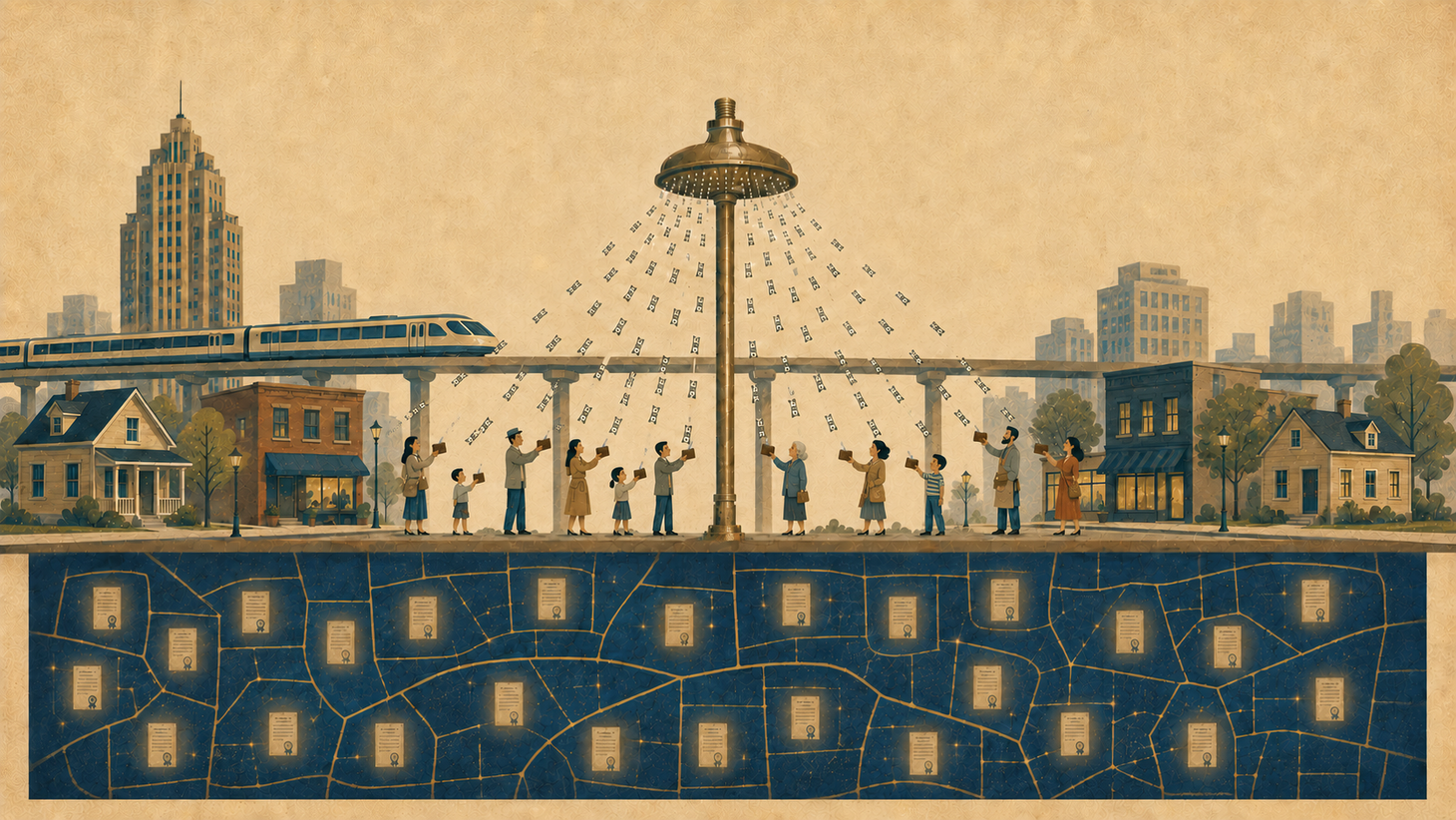
Why taxing the value of land is potentially the best tax for universal basic income by making housing cheaper, taxing AI indirectly, and pushing rents down instead of up
Imagine two plots of land in the heart of a big city, side by side, the exact same size. On one stands a gleaming fifty-story tower full of offices and apartments and shops. On the other sits a zero-story parking lot.
Now ask yourself: which owner pays more in taxes?
The tower owner does. We tax the building, so the more you build, the more you owe. The parking lot owner, who built almost nothing, pays almost nothing, even though the dirt beneath that asphalt is worth a fortune precisely because it sits in the middle of a thriving city that everyone else built up around it. So the parking lot just sits there. Year after year. The owner pays their small tax, and watches the land’s value climb—value they did nothing to create, mind you—waiting to sell for a huge windfall.
I think that’s pretty perverse, and a land value tax (LVT) is built to fix it.
A land value tax is a tax on the unimproved value of land: the worth of a location itself, not the buildings or improvements sitting on it. That value isn’t created by whoever holds the deed. It’s created by the whole community around it. A land value tax, paired with a universal dividend, can give that value back to everyone in equal shares. It may be the closest thing we have to a perfect tax. It can’t be hidden or dodged. It makes housing cheaper instead of more expensive. And I believe it’s the best way to capture and share the enormous wealth that technology is concentrating into very few hands.
It’s also the final layer of a broader multi-layered universal basic income plan I’ve been building. But it stands on its own, so let me start from the ground up.
What a land value tax actually is
First, a land value tax is not a property tax. It’s really important to understand the difference between the two.
A property tax taxes everything. It taxes the land and whatever is built on top of it. Build a house, add a bedroom, fix the roof, put up an apartment building instead of a house, and your tax bill goes up and up. You get punished for improving things.
A land value tax taxes only the unimproved value of the land itself. Whatever you do on top of it is yours, tax-free. Build a skyscraper or build nothing, the land bill is the same.
Why do it that way? Because, you do not create the value of the land you own. Nobody does individually. The value of land comes from everything around it: the roads, the transit, the schools, the hospital, the grocery store, the coffee shops, the neighbors, the jobs, the whole humming civilization that grew up around that spot. Land appreciates because of the work society does around it. Society makes the land valuable. So when we collect that value and share it, we’re not taking anything any one individual earned. We’re returning something we all made together.
This is one of the oldest ideas in economics, and it was once hugely popular.
The book that diagnosed the problem
In 1879, an American named Henry George published a book called Progress and Poverty, and it became one of the best-selling books of the nineteenth century. Working people devoured it, all around the world. The question George asked was the one everyone was and still is: why, in an age of breathtaking technological and industrial progress, did poverty keep getting worse?
His answer was basically, “It’s the land, stupid.” As a society grows richer, the people who own the land capture the gains. Everyone else pays them rent for the privilege of existing near all that progress. George wrote that the great cause of inequality in the distribution of wealth is inequality in the ownership of land.
Every gain a society makes—be it a new technology, a growing population, or a better-run city—makes the land more useful, and so makes it more valuable. But that gain doesn’t lift wages. It gets soaked up into the price of the ground and skimmed off as rent. Work harder, invent more, accomplish more, and landlords simply raise the rent. That is why progress and poverty advance together.
Look around. This process is still happening. It’s a fundamental economic problem.
We generate staggering wealth in places like the SF Bay Area and New York City. And what happens? It becomes more and more expensive to live there. The engineers and nurses and teachers who make those cities run get priced out, while the people who happened to own the dirt get richer for doing nothing. The wealth we create together flows to whoever holds the deed. That’s how the system is designed to work. It’s a system designed by landowners. And George diagnosed it and prescribed the solution about 150 years ago.
The wealth tax that can’t run away
Here’s another thing land does: it sits there out in the open. You cannot hide it.
We have spent decades watching the very wealthy stash money in shell companies and offshore accounts. You can’t do that with land. Land cannot be wired to the Cayman Islands. A land value tax is therefore an unavoidable wealth tax. It’s one of the only ones we’ve got that the rich can’t evade.
When you have more money than you could ever spend, your money goes hunting for assets to buy, and land is the most-loved asset. Extreme wealth inequality is already driving up the cost of housing for this reason. As AI drives a tsunami of even more wealth toward a handful of people, that wealth will pour into real estate too, concentrating land into fewer and fewer hands and further pricing everyone else out.
History has a lesson for us. The cotton gin did exactly what AI will likely now do. It made human labor way more productive but the gains did not flow to the people whose labor it saved. The gains flowed into land. The price of cotton-growing land soared. Those who owned it grew richer, and slavery, which some had expected to be hurt by the new technology, instead worsened. A labor-saving machine made the owners of land more powerful, not the workers. AI is the cotton gin of our century, and without a land value tax, the gains will pool in the same place they always have.
AI is already landing — literally
We don’t even have to wait to watch it happen. It’s happening. Every AI model runs on data centers, and data centers have become the most expensive land use in America. In Loudoun County, Virginia, one plot recently sold for $6 million an acre.
And Loudoun shows what happens when a community actually taxes that. Data centers now generate about $1.3 billion a year, roughly 45% of the county’s tax revenue. It’s so much that the county has cut its residential property tax rate every year for a decade, down 30%, even as its budget grew. The tech industry’s hunger for land actually lowered bills for homeowners. That’s a land dividend in embryonic form: the wealth of the AI age flowing back to the residents whose community hosts it.
Most places are doing the opposite. At least 37 states now subsidize data centers with tax exemptions; Virginia’s alone was projected to cost $1.5 million a year and now costs $1.6 billion. We are paying trillion-dollar companies to occupy our land. As Greg Miller of the Center for Land Economics argues, communities shouldn’t reject data centers or subsidize them; they should negotiate harder. Wherever AI touches down, the land beneath it soars in value, and the tax converts that surge into a dividend for everyone who lives there. No lobbying, no shell companies, no races to the bottom. The more valuable AI makes the land, the bigger everyone’s check can be.
So a land value tax is, in a very real sense, a way to tax the automation of work indirectly. We don’t have to chase every token or tax every robot to capture the gains from automation. We can let the money do what money does—flow into land—and tax it there. Then we spread it back out, universally, so that everyone benefits.
Why homes would get cheaper and why that needs a dividend
Now for the part that makes some people nervous and it’s part of the reason we don’t already tax land value. A land value tax would reduce the sale price of homes. How? A recurring tax on land gets “capitalized” into a lower purchase price. If owning land carries a higher annual bill, buyers won’t pay as much up front for it. The future tax shrinks what the land is worth as an investment.
Cheaper land means cheaper homes. For renters and first-time home buyers, that’s fantastic. But for everyone who already owns a home, their single biggest asset would be worth a bit less. That’s a real issue. Pretending otherwise is dishonest.
I think about this the way I think about universal healthcare. I believe moving to a single-payer system would be an enormous good. It would cover everyone and cost less. It would also put a lot of people who work in private health-insurance administration out of a job. That doesn’t make universal healthcare a bad idea. It makes it an idea that has to come with a way to make the transition less painful.
Same here. Lowering the wealth locked up in homes is good for affordability and bad for anyone counting on their house as their retirement security. That is exactly why LVT needs a dividend, and exactly why it should be on top of other dividends. A land value dividend compensates for reduced housing wealth. And more deeply, it changes what security even means. Instead of “buy land when young and pray it appreciates,” your security comes from a lifelong check that arrives every month no matter what. It’s also a better incentive structure for investing. As Stephen Hoskins argues, taxing land “removes land’s role as the central pathway to retirement-saving” and pushes people to invest in productive businesses instead of speculating on dirt. That’s healthier for everyone, but only if there’s a floor underneath people while the old rules change. The dividend is that floor.
And to be clear, none of this means anyone gets forced out of their home. As Henry George himself insisted, we don’t need to confiscate land—just the rent: “We may safely leave them the shell,” he wrote, “if we take the kernel.” The worry that always comes up here is the retiree who owns a now-valuable home but lives on a fixed income. The fix is simple: let owner-occupiers defer the tax until they sell the home or pass it on. The bill comes due only when the land changes hands. Nobody need be evicted by a land value tax.
The incentive that can’t backfire
Whatever you tax, you tend to get less of. Tax cigarettes, people smoke less. Tax fuel, people drive less. Tax work, people work less. Tax consumption, people consume less. Tax buildings, people build fewer buildings—which is the disaster of the property tax.
Land is the magnificent exception. You cannot get less land by taxing it. The supply is fixed. Tax it at any rate you like and there is exactly as much land tomorrow as there was today.
So what does the tax do? It discourages land speculation. Right now it’s comfortable to hold a vacant lot or an empty house and wait for the neighborhood to do the work of making it valuable. A land value tax makes that waiting expensive. Suddenly the parking lot owner is paying the same as the skyscraper owner next door, and the only way to pay that bill is to put the land to use. Convert the parking lot to a 20-story parking structure. Or build a big apartment building. Or build a skyscraper. Or sell to someone who will.
The result is a tax that increases the supply of housing. More housing means more affordable housing. LVT is a tax that encourages making more of the thing we desperately need more of. That’s why Milton Friedman called the tax on the unimproved value of land “the least bad tax,” reaching all the way back to invoke “the Henry George argument of many, many years ago.”
Public investments, private windfalls
There’s one more source of land value we haven’t covered yet, and it’s the one we all pay for most directly: public investment. Announce a new light rail line through a neighborhood and the land along it instantly shoots up in value before a single rider ever boards a train. The same goes for every new school, park, sewer line, and levee. Public money goes in, and the value of the surrounding land goes up. The economist Joseph Stiglitz proved this formally in 1977 in what’s now called the Henry George Theorem. Spending on public goods tends to reappear as higher land values, by at least as much as the public spent.
New York just wrote this insight into law. Tucked inside the state’s latest budget is a renewed provision (Section 119-r) authorizing New York City to capture the land value created by new transit lines, through a special assessment or an outright land value tax, to help pay for the Interborough Express between Brooklyn and Queens. By one Niskanen Center estimate, that single line could generate $1.5 to $3.5 billion in capturable land value. Build the train, tax the windfall it creates, and the train helps pay for itself.
Now contrast that with how it usually goes. The entire tax base pays for the rail but the gains fall like a lottery prize on whoever happened to already own land nearby. But they didn’t build the rail line. The public did. A land value tax says: if public investment created the value, the public should share the value.
Why a dividend, and not just a tax cut
Some people, hearing all this, will say: fine, tax land, but use it to cut other taxes. Lower the property tax or income tax. Lower the sales tax. Just cut taxes.
This is the same problem I wrote about in my proposal to replace the standard deduction with a standard credit. Cutting taxes helps the rich more, because they pay the most tax to begin with. A dividend helps everyone equally, because it’s the same dollar amount to every single person.
I believe a universal dividend is the most fair way to handle land value, for the reason I’ve come back to again and again: everyone in the community creates the value of the land in that community, even those who don’t pay any property tax. The barista, the bus driver, the nurse, the kid in school; they are all part of why that land is worth what it’s worth. So when we collect the value of the land, everyone should get an equal share back. Not a tax cut weighted toward whoever currently owns the most. A dividend, weighted toward everyone equally.
Watch what that does to different people:
A renter pays nothing into a land value tax. Renters don’t own land. So a renter receives the dividend and pays zero for it. It’s pure gain for them.
A family who owns their own home and lives in it sees their land tax go up, and their combined dividends cancel it out. It’s roughly a wash. They’re fine.
Meanwhile, someone who owns lots of homes pays a higher tax on every one of those plots and receives exactly one dividend. That’s the whole design. It makes hoarding homes more expensive and makes owning your own home far easier. LVT-UBI gently pries land out of the hands of the few and puts it within reach of the many.
I guarantee you that private equity funds that own tens of thousands of homes hate this idea. Oh well, I guess they’ll have to sell some homes to actual people. C’est la vie.
But won’t rent just go up?
The most common fear people have about UBI is that landlords will just raise rents to capture it. It’s a fair fear. It’s also the fear a land value dividend is best built to answer, because every pressure it creates on rent points downward.
Start with supply. As we already covered, a land value tax makes it expensive to sit on vacant lots and empty homes, and it makes building more the best way to cover the bill. More housing means more choices, and more choices means landlords competing for tenants instead of tenants competing for housing.
Then add homeownership. A land value tax lowers the purchase price of homes, and a dividend helps people save up for one, while the tax makes hoarding homes a losing game. Every renter who becomes a homeowner is a customer landlords lose. Fewer renters chasing more homes pushes rents down further.
Then add mobility, which I think is the most underrated effect of all. Right now, most people have to live where the jobs are, which means landlords in expensive metro areas face no real competition from landlords elsewhere. But a UBI is income that follows you wherever you go. Suddenly the person paying too much in a costly city can move somewhere cheaper without giving up their income floor. We already ran a version of this experiment. When the pandemic made remote work normal, people spread out, and rents fell in the densest, most expensive areas while rising in cheaper surrounding ones. UBI would extend that freedom beyond remote workers to everyone, forcing landlords in cities to compete with landlords in cheaper areas.
And if rents do still rise somewhere? Then land values rise there too, the tax collects more, and everyone’s dividend grows. Instead of a rent increase enriching only the landlord, it funds a bigger check for everyone. A land value dividend is a version of UBI where the thing people fear about it automatically pays for more of it.
What the numbers look like
The UBI Center looked at a UK land value dividend. They modeled a 1% tax on land value which raised roughly £55 billion a year in 2021. As an equal dividend to every person, child and adult alike, that’s about $100/mo in 2026 USD. That may sound small but that’s a poverty reduction of 20%. The bottom tenth of the UK would see its income rise by 16%. The top tenth would see its income fall about 2%. Overall, 70% of people would come out ahead.
Now run the same logic for the United States.
Estimating that the privately held land here is at least $36 trillion, a 1% land value tax on that base would raise roughly $360 billion a year. Spread it equally across all ~320 million American citizens and green card holders, adults and children alike, and that’s about $90 a month.
I'd then suggest phasing it up to 5% over five to ten years. Why 5%? Because that's roughly the rate that collects 100% of rent. Land typically earns its owner about 5% of its price in rent each year, so a tax of 5% of today's land value amounts to collecting nearly all of the annual rent of land which is exactly what Henry George proposed we do. And yes, taxing away the rent means land prices themselves would fall. That's the point. The revenue comes from the rent that land generates every year, not from its sticker price. At 5%, the same math yields roughly $1.8 trillion a year—about $470 a month per person—and it keeps growing as land keeps becoming more valuable to use, which it always does. Stack that onto other UBI layers and we're talking about real money, paid to everyone, for their entire lives, sufficient to end absolute poverty.
Why this layer is state-by-state, not national
There’s a problem though. At the federal level, a land value tax runs straight into the Constitution. The Constitution treats a tax on land as a “direct tax,” and it requires direct taxes to be apportioned among the states by population, with each state owing a share that matches its head count. That’s unworkable for a land tax, because land value isn’t distributed by population. The Sixteenth Amendment carved out income taxes from this apportionment rule in 1913, but it never touched taxes on land. So a genuine nationwide land value tax would likely require a constitutional amendment.
That’s a high bar. But here’s the good news: any state can tax land value on its own. A state might need to amend its own constitution to do it, but amending one state’s constitution is a far lighter lift than amending the entire nation’s.
So this is the UBI layer I imagine arriving state by state, county by county, city by city, or some mix of all three. Land value dividends would sit on top of the national UBI layers, the way Alaskans already receive their universal dividend on top of whatever the federal government happens to provide.
This also creates a beautiful competition. A state that adopts a land value dividend makes its housing more affordable and puts money in every resident’s pocket, which attracts people to move there. States that refuse will watch their residents leave. For once, the race between states would be a race to affordable housing and economic security.
Pennsylvania already ran the experiment
Pennsylvania has already shown the good sense of taxing land value. Until this year, it was the only state with widespread municipal use of split-rate property taxes where land is taxed at a higher rate than the buildings on it. Nearly twenty municipalities have done it. Harrisburg adopted a two-rate tax in 1975 to fight Rust Belt blight. Over the next two decades, its vacant structures fell from more than 4,000 to around 500, and its number of businesses more than quadrupled. A study of fifteen Pennsylvania municipalities found that shifting the tax toward land grew construction, and a Lincoln Institute analysis found split-rate towns grew their housing stock roughly five percentage points faster than comparable single-rate towns.
Pennsylvania isn’t even America’s first run at this. In 1912, Houston taxed land at 75% of its value while taxing buildings at only 25%. The results: rents fell 20%, construction jumped 66% in six months, vacant lots filled in, and bank deposits surged. The tax commissioner behind it, J. J. Pastoriza, proved so popular that he won re-election and then the mayor’s office. And the experiment didn’t end because it failed. It ended because the Texas Supreme Court struck it down, to the delight of land speculators who were upset precisely because it worked. Sound familiar?
New York City tells the same story from another angle. In the 1920s, the city exempted new buildings from property taxation by taxing only the land underneath and set off the biggest housing construction boom in its history; one so big it ended the city’s housing shortage in just three years. A city facing a critical shortage, rent-gouging landlords, and inflated land prices built its way out, not with vast public spending, but by changing what it taxed. Taxing buildings less got more buildings. A century later, NYC is circling back to the same insight with its new transit provision.
This idea is finally spreading again. By the Center for Land Economics’ count, LVT went from no state legislation three years ago to two states expanding LVT authority in 2026, seven more with active bills, and two more with emerging interest. Something is shifting. The momentum is unmistakable.
South Korea might beat us all to it
And it isn’t only an American story. South Korea may become the first country on Earth to fund a basic income with a nationwide land value tax. Its president even campaigned on it.
Lee Jae-myung, now South Korea’s president, has spent more than a decade turning basic income from idea into policy. As governor of the country’s largest province he ran a real basic income program for young adults. And in his 2022 presidential run he proposed a national UBI funded primarily by a land value tax and a carbon tax; the argument being that land value belongs to the public and that taxing it can both fund a dividend and curb the real estate speculation eating the country alive. He lost that race by less than one percentage point, in part because opponents stoked fear about real estate taxes. He then won the presidency in 2025 and continues to expand the number of people receiving basic income, starting in rural areas.
And no country on Earth is better equipped to do it. The most common practical objection to a land value tax is that you can't credibly value land separately from the buildings on it. South Korea already does. Every parcel in the entire country, separately from buildings, every single year, with the whole national operation completed in five months and the results published publicly down to the individual lot. The valuation machinery the critics say is impossible is already running there. All that's left is to attach the tax and dividend there too. LVT-UBI is so close there.
The full UBI stack
Now look at all my proposed UBI layers:
- Layer 1: replace the standard deduction with a refundable standard tax credit.
- Layer 2: a stock dilution dividend — a wealth tax the rich can’t dodge.
- Layer 3: a consumption dividend — a VAT or a tiny tax on transactions.
- Layer 4: a carbon dividend — a Pigovian tax on pollution.
- Layer 5: a land value tax and dividend — implemented state by state.
The first layer is a pretty boring but effective tax reform, but the other layers are all meant to distribute dividends based on shared ownership and collective value creation.
This final layer is the oldest idea in the whole UBI story. Thomas Paine argued in 1797 that the earth is the common inheritance of all, and that landowners owe the rest of us a ground-rent for it. Henry George built a movement on it. Alaska has been paying its residents a dividend on shared natural resource wealth since 1982, and no Alaskan calls it welfare. They call it their rightful share. A land value dividend is simply that same logic, applied to the most valuable resource we hold in common and the one nobody can take offshore. Plus it will solve the landlord problem and make both renting and owning housing more affordable.
The skyscraper and the parking lot will always sit on equally valuable ground. The only question is whether the value of that ground keeps flowing to whoever got there first and made the rules, or whether, at last, it flows to everyone who creates its value.
I think it’s past time we collect the rent we’re owed and pay it to ourselves.
If reading this was worth your time, it’s worth sharing with others. Share it, subscribe for free, and if you can, make a monthly pledge or buy a paid subscription to keep this work going.

Thank you to my UBI Producer level patrons and paid Substack subscribers: Gisele Huff, Steven Grimm, Bob Weishaar, Judith Bliss, Lowell Aronoff, Jessica Chew, Katie Moussouris, Tricia Garrett, Oliver Bestwalter, Daryl Smith, Larry Cohen, John Steinberger, Philip Rosedale, Frederick Weber, Tom Cooper, Joanna Zarach, Mgmguy, Albert Wenger, Jeremy Wertheimer, Andrew Yang, Kimi Avary, Peter T Knight, Michael Finney, David Ihnen, Paradigm shift, Miki Phagan, Draper Kauffman, Webmemo, Elizabeth Corker, Albert Daniel Brockman, Joe Ballou, Felix Ling, Jocelyn Hockings, Mark Donovan, Steve Roth, Jason Clark, Chuck Cordes, Mark Broadgate, Leslie Kausch, centuryfalcon64, Deanna McHugh, John Sullivan, Stephen Castro-Starkey, CodyS, chris heinz, Zachary Weaver, bradzone, Tim, Warren J Polk, Jeffrey Emmett, Nicolas Pouillard, Eric Skiff, Thomas Welsh, Karla Hagemeister, Mark Pierce, Fred Weber, Linda Hearne, David Allen, Janos Abel, Wendy Voahangy Ravano, Liz, and all my other monthly patrons for their support.
Do you support UBI as a tech dividend? If so, have you signed the AI Pledge for Humanity yet?


UBI Guide Newsletter
Join the newsletter to receive the latest updates in your inbox.