Top 10 Universal Basic Income Articles of 2025


As host of The Basic Income Show and moderator for the Basic Income subreddit, I read hundreds of article every year about UBI. Below, I’ve compiled a list of the top ten articles I consider my favorites out of everything published in 2025.
A big thanks to my monthly patrons who contribute to making articles like this possible and free for everyone. If you find value in my writing and would like to support the creation of more content like this, please check out my Patreon page.
- A Kantian Approach to Everything? On Life Choices and Universal Basic Income by Julieta Elgarte
To start this list, I’ve chosen a philosophical piece from the American Philosophical Association’s blog that approaches basic income from a Kantian perspective. Julieta Elgarte, a philosopher at Universidad Nacional de La Plata in Argentina, argues that we should try to make our life choices not merely as means to external ends, but as ends in themselves—and that UBI is the policy that makes this possible for everyone.
I’ll admit part of why I loved this article so much is that I read How to Be Perfect by Michael Schur last year and it stuck with me. Schur’s accessible tour through moral philosophy left me thinking a lot about Kant’s categorical imperative—the idea that you should never use someone merely as a means to an end—as a general rule to live by if you want to try to be a good person. So when I came across Elgarte’s piece applying that same framework to UBI, it immediately resonated.
What I appreciate about this article is how it frames the case for UBI through the lens of autonomy in relationships and work. Elgarte explains how economic dependency traps people, especially women, in relationships they might otherwise leave, and forces young people to instrumentalize (treat as a means to an end) their very lives by choosing careers based on expected income rather than passion or calling.
Here’s her core argument:
“By freeing young women and men from the economic insecurity that pushes them to instrumentalize their very life—from their most intimate relationships through the abilities they choose to develop to the contribution they make to the world through their everyday work—a UBI would give them the real freedom and the genuine opportunity to choose what they inherently value: to marry for love and to work on their calling.”
This is a great article to share with anyone interested in philosophical foundations for UBI, and it’s a refreshing approach that connects Kant’s famous categorical imperative to concrete policy.
Continuing the philosophical thread, this piece introduces readers to André Gorz, a thinker who long ago anticipated our current moment. Gorz, who fused existentialism, Marxism, and ecological thought, argued in his 1980 book Farewell to the Working Class that automation would make necessary labor progressively obsolete—but that capitalism would cling to employment as a moral obligation anyway.
What makes this article valuable is how Arda Tunca connects Gorz’s decades-old insights to the AI economy. Gorz foresaw the “productivity-without-prosperity” dilemma: technological abundance coexisting with economic insecurity, wages stagnating while output soars, workers pushed into precarious service jobs. His observation that “capitalism cannot survive without making labor compulsory, even when it becomes unnecessary” describes our current situation with eerie accuracy.
Gorz proposed universal basic income not as a way to preserve consumption, but to guarantee autonomy—freedom from market dependency. A basic income would allow people to divide their lives between paid work, care, art, study, and civic participation. He envisioned what he called a “civilization of time” rather than a “civilization of work.”
“The question is not how to make people fit for the system, but how to make the system fit for people.”
For anyone looking for a deeper philosophical grounding for the case that AI demands UBI, Gorz is essential reading, and this article is an excellent introduction to his thought.
- Basic Income in Canada is Closer Than You Think by Nancy Wilson
For those following UBI developments in Canada, this article for Rabble is a great update. Nancy Wilson writes about Senate Bill S-206, the National Framework for a Guaranteed Livable Basic Income Act, which passed second reading and is currently before the Standing Senate Committee on National Finance. This isn’t a pilot. It’s real legislation working its way through Parliament to form a real plan for basic income.
Wilson does a great job contextualizing the bill’s journey, noting how NDP Member of Parliament Leah Gazan first introduced a similar bill (C-223) in 2021, which died on the vine in 2024, and how Senator Kim Pate has persistently revived the effort. This continuity matters because it shows basic income is no longer tied to a single politician or party—it’s a sustained policy effort with institutional backing.
She also reminds readers of Mincome, Canada’s famous basic income experiment from the 1970s in Manitoba, and its findings: modest reductions in work hours (mostly among new mothers and students), a 17.5% drop in crime rates, and improvements in physical and mental health.
“Basic Income isn’t a utopian dream. It is a real policy initiative that is working its way through Parliament right now.”
Anyone who thinks UBI is politically impossible should read this article.
- The Cruel Catch-22 of Cash Aid by Mother Jones
This Mother Jones piece is essential reading for understanding one of the biggest obstacles facing guaranteed income programs in the United States: the benefits cliff. It tells the story of Portia, a 27-year-old mother in Flint, Michigan, who is paralyzed below the waist and receives $936 monthly from Supplemental Security Income. When she enrolled in Rx Kids, a guaranteed income program in Flint giving $1,500 to expectant mothers plus another $500/mo for the year after birth, she faced an impossible choice: each $500 payment would trigger a nearly equal reduction in her SSI.
“If I wouldn’t have taken the $500, that would have been another two weeks before I was able to put anything in my refrigerator. These are the decisions that people are forced to make.”
The article explains how this problem has existed since at least the 1970s, when researchers running “income maintenance” experiments in Seattle and Denver were puzzled that eligible residents passed on more money than welfare offered—because signing up meant losing other benefits and having subsidized rents raised.
What’s particularly frustrating is how close we came to fixing this. Former Social Security Commissioner Martin O’Malley was working on regulations that would have protected SSI recipients who receive guaranteed income payments, but the effort evaporated after the 2024 election. “We were so close,” says Kathleen Romig, who was helping iron out details at the agency.
This is the kind of article that helps people understand the issues with the conditions and means-testing of existing programs, and to consider what potential reforms existing programs should face in a post-UBI world.
Should anyone ever be worse off if their incomes increase for any reason? UBI makes sure the answer to that is “No.”
- Yes, Cash Transfers Work by Annie Lowrey
Annie Lowrey, author of the book Give People Money, returns with this Atlantic piece that serves as a powerful rebuttal (aside from my own) to recent skepticism about cash transfer programs. Some critics have pointed to “lackluster” results from recent pilots—Denver’s program didn’t significantly reduce homelessness compared to the control group, Compton’s didn’t significantly improve psychological well-being, the OpenResearch pilot didn’t significantly bolster health outcomes. But Lowrey argues these critiques overinterpret limited evidence while ignoring decades of research showing cash works.
She makes several important points. First, the recent pilots took place during and after the pandemic, when Congress was already flooding families with stimulus checks and enhanced unemployment—making it harder to isolate the effects of any single program. Second, they occurred during an acute cost-of-living crisis brought on by post-pandemic inflation.
But her most important point is this: the pilots did reduce poverty. Participants had more money to spend on housing, transportation, and food. Mothers were less likely to be in poverty.
“You give people money; they have money.”
She also reminds readers that the strongest benefits of cash transfers often take time to appear. Mothers’ pensions from the 1910s-1930s had muted effects on the women receiving them at the time, but significant effects on the lifetime earnings and educational attainment of their sons, decades later.
This is an article to share whenever someone claims some basic income pilots “failed.”
- What Does Global Justice Look Like in the 21st Century? by Philippe Van Parijs
It’s always great to read something new from Philippe Van Parijs, widely regarded as the godfather of UBI. In this Jacobin interview, he discusses his intellectual trajectory, the prospects for basic income in the age of AI, and the dilemmas of justice posed by mass migration.
Van Parijs offers an important corrective to the typical AI-based case for UBI. He doesn’t expect AI to make the world jobless, but he does believe it will further polarize the distribution of earning power and wealth. UBI, combined with massive expansion of lifelong learning, can counteract this trend.
On migration, he’s characteristically thoughtful. He acknowledges the tension between opening borders and protecting the interests of the worst-off among locals, but refuses to conclude that borders should stay closed:
“High rates of immigration do not make life easier for a generous basic income, but they do not make it impossible.”
What I especially appreciate is his honesty about his own intellectual positioning. When asked about his relationship to Rawls and Marxism, he says he’s “probably best labeled a left-Rawlsian rather than a Marxist” and explains exactly where he finds Rawls insufficiently egalitarian.
This interview is essential reading for anyone interested in the philosophical foundations of UBI and how it connects to broader questions of global justice.
- Basic Income as Power to the People by Karl Widerquist
This essay is a preview of Karl Widerquist’s forthcoming book for the Janus Debates series, and it’s one of the most powerful articulations of the freedom case for UBI I’ve read recently. Karl’s central argument is that UBI gives ordinary people something they desperately lack: real power.
He starts with a critique of our existing checks on power. Our vote is one among millions, easily outweighed by donor money. In the marketplace, we call ourselves “free labor” because we can say yes or no to any one employer, but we lack the power to say no to all the bad choices. A livable UBI changes that:
“A livable UBI is the ultimate check in government and in economics, because it devolves one important piece of real power to everyone as an individual: the freedom from labor-market dependence; the power to say no to any and all employment.”
What I love about this piece is how Karl systematically works through the implications. UBI gives workers the power to demand better wages and conditions. It gives women the power to leave abusive relationships. It gives unions an “inexhaustible strike fund.” It even helps people make better reproductive choices by reducing the financial penalty for having children.
He also addresses the common objection that people won’t work:
“Some people, especially privileged people, allege that we won’t work if UBI exists. We should ask them, are your job offers so terrible that no one with the power to refuse would take them?”
This is an article to bookmark and share whenever someone asks why UBI matters beyond just reducing poverty. It’s about power to the People.
- Just How Many More Successful UBI Trials Do We Need? by Katie Jagielnicka
Katie Jagielnicka’s piece for The Noösphere is built around a simple but devastating question: at what point does the evidence become sufficient? She writes in response to the results of Germany’s three-year basic income study, in which 122 people received €1,200 monthly with no strings attached.
The results were overwhelmingly positive. Participants worked 40 hours per week on average—identical to the control group. They reported greater job satisfaction and were more likely to change jobs or pursue education. They saved more money and donated more to charity. Women, in particular, experienced significant increases in autonomy.
But Katie’s larger point is that Germany is just one of many successful trials. She walks through GiveDirectly’s 12-year experiment in Kenya, Finland’s state-run study, Canada’s Mincome, and dozens of others. The pattern is consistent: people don’t stop working, health improves, and the feared social collapse never materializes.
“If governments were genuine in saying they will apply ‘evidence-based policy’, we would have a basic income system already.”
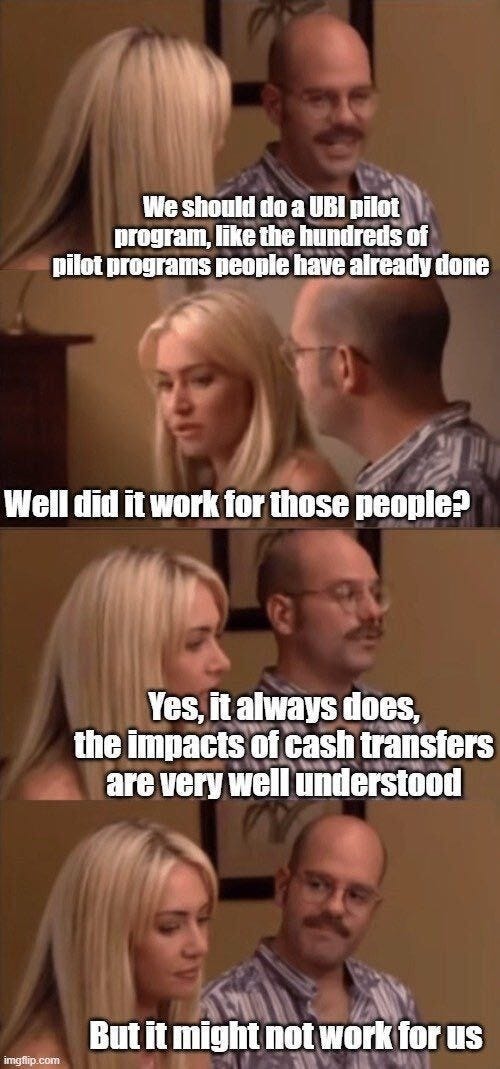
This article resonated with me because I've been saying the same thing for years—but what really excites me is that it's no longer just UBI advocates making this point. The frustration Katie expresses is becoming mainstream. "Of course that basic income pilot was a success" is turning into its own meme, because what else would you expect from the two hundredth study to reach the same conclusion? We've developed this strange habit of endlessly re-testing policies we already know work while refusing to actually implement them, and UBI is finally being recognized as exhibit A.
- Labor Supply Responses to a Very Large Income Shock:Evidence from Daughters of Brazilian Military Officers by Marcelo Ferreira
My article about this one is here if you’d prefer to read that to an 80-page academic paper, but this research is by Marcelo Ferreira at Princeton is so important that I had to include it despite it being a long paper. Ferreira analyzed what amounts to a long-term natural experiment in Brazil: lifetime pensions for daughters of military personnel that date back to 1795 under the Portuguese Empire.
What makes this study remarkable is its scale and duration. This wasn’t a two-year pilot with a few hundred participants. Ferreira analyzed data from over 30,000 people receiving permanent, unconditional income ranging from poverty-level amounts to the equivalent of $15,000 per month. If the laziness myth were true, we’d expect labor force participation to collapse at those higher amounts.
It didn’t. The income elasticity of labor supply was extremely low. For every dollar given, labor earnings fell by just 8 cents on average. People who continued working didn’t reduce their hours at all. The reduction came entirely from some women dropping out of the workforce or taking longer between jobs—often to do unpaid care work or be more selective about employment or to just retire a few years earlier.
When combined with the 2020 systematic review finding that 93% of trials showed no meaningful work reduction, and the 2025 End of Year Report covering 27 American pilots that found zero showed a decline in employment, the conclusion is inescapable:
People are afraid of a bogeyman. Unconditional basic income is the foundation of work, not the enemy of it. This debate is over.
- The Best Books on Universal Basic Income by Matthew Johnson
My favorite article of 2025 is this Five Books interview with Matthew Johnson, Professor of Public Policy at Northumbria University and chair of the Common Sense Policy Group. What I love about it is how it weaves together the philosophical, economic, and political case for UBI through a discussion of five influential books—and in doing so, creates an incredibly accessible and informative introduction for newcomers while offering fresh insights for veterans.
Johnson selects a fascinating range: Marx’s The German Ideology for its emphasis on how material conditions shape our worldview; Hayek’s The Road to Serfdom, which could surprise people with its arguable endorsement of basic income; Philip Pettit’s Republicanism on freedom from domination; and Guy Standing’s The Precariat on the changing nature of work.
What makes this interview exceptional is Johnson’s willingness to be direct about the political obstacles. When the interviewer asks about cost, he doesn’t hedge:
“Tax rich people. This is supposedly a rich society, in which rewards from working are reducing relative to rewards from wealth.”
He’s equally blunt about the current UK government’s inadequacy and the need for large-scale public investment. But he also makes the affirmative case that UBI isn’t charity—it’s recognition of our shared inheritance:
“UBI should be seen not as a handout but as a rightful share of common wealth.”
Johnson explains why universality matters (it ensures the poorest actually receive benefits, unlike targeted programs with high exclusion errors), why unconditionality matters (it doesn’t create poverty traps), and why basic income changes everything by working through three pathways: increased resources, increased security, and increased predictability.
This is a fantastic recommendation for anyone wanting a comprehensive introduction to UBI. Bookmark it, share it, and consider reading the books he recommends.
Bonus: The Marshall Islands Just Quietly Implemented the First National Universal Basic Income by Scott Santens
I’m including this as a bonus because I wrote it, but the news itself is potentially the biggest UBI development in decades, and everyone who supports basic income needs to know about it.
In late 2025, the Republic of the Marshall Islands passed and funded a nationwide, legally established, permanent universal basic income called “Enra.” This is not a pilot. Not a time-limited experiment. It’s a permanent system paying every citizen living in the country $200 every three months, with children included. There’s no means test and no work requirement.
Relative to their economy, this is equivalent to the United States paying everyone about $750 per month—around 10-11% of GDP per capita. The program is funded by a U.S.-capitalized sovereign wealth fund created under the Compact of Free Association, essentially making it a national dividend similar to Alaska’s Permanent Fund but at a much larger scale relative to their economy.
A sovereign nation has now legislated a permanent, nationwide, unconditional, individual, regular cash payment to all citizens. It has committed around 8% of GDP to that UBI and another 6% to additional distributions for higher-need communities. It has funded it from a sovereign wealth fund built from external rents.
For larger economies, this isn’t a plug-and-play blueprint, but it is a clean proof of concept. A government can decide that a share of national wealth should be paid out as universal basic income. The Marshall Islands just did exactly that.
So, who’s next?
Bonus Meme: Nothernlion’s Extremely Important PSA
I haven’t done this before, but my meme of the year goes to Northernlion.
You need healthcare and universal basic income. Don’t get distracted!
I hope you found this list helpful and if you want to avoid missing any great articles about UBI in 2026, consider a daily visit to the Basic Income subreddit, subscribing to monthly UBI news updates via my ITSA Newsletter, and following @ScottSantens on Bluesky, YouTube, and everywhere else I am where you are too.
Want more content like this? Please like it, share it, and click the free subscribe button. Also consider making a monthly pledge in support of my UBI advocacy work.

Thank you to my UBI Producer level patrons: Gisele Huff, Haroon Mokhtarzada, Steven Grimm, Bob Weishaar, Judith Bliss, Lowell Aronoff, Jessica Chew, Katie Moussouris, David Ruark, Tricia Garrett, A.W.R., Daryl Smith, Larry Cohen, John Steinberger, Philip Rosedale, Liya Brook, Frederick Weber, Dylan Hirsch-Shell, Tom Cooper, Joanna Zarach, Mgmguy, Albert Wenger, Andrew Yang, Peter T Knight, Michael Finney, David Ihnen, Steve Roth, Miki Phagan, Walter Schaerer, Elizabeth Corker, Albert Daniel Brockman, Joe Ballou, Arjun Banker, Tommy Caruso, Felix Ling, Jocelyn Hockings, Mark Donovan, Jason Clark, Chuck Cordes, Mark Broadgate, Leslie Kausch, Juro Antal, centuryfalcon64, Deanna McHugh, Stephen Castro-Starkey, David Allen, Liz, and all my other monthly patrons for their support.
Looking for a UBI-focused nonprofit charity to donate to? Consider donating to the Income To Support All Foundation to support ambitious UBI projects focused on research, storytelling, and implementation to realize economic freedom for all.

UBI Guide Newsletter
Join the newsletter to receive the latest updates in your inbox.